
General Christian Piquemal, who commanded the French Foreign Legion from 1994 to 1999, died on October 23, 2026, at the age of 85. A funeral Mass was held on October 30 at the Church of Saint-Sauveur in Aubagne, the Legion’s main garrison town. In accordance with his final wishes, his ashes are to be laid to rest in the Legion veterans’ communal vault at the Foreign Legion Institution for Disabled Veterans (IILE) in Puyloubier.
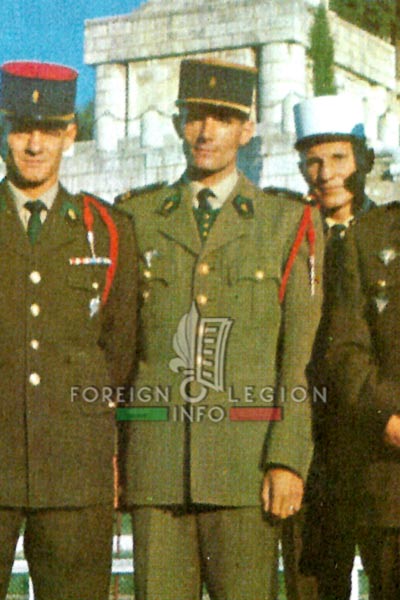
Born on December 17, 1940, in Huos, in the Haute-Garonne department of southwestern France, Piquemal entered Saint-Cyr, France’s equivalent of West Point, in 1960. On graduating from the Infantry School at Saint-Maixent, he chose the Foreign Legion. In August 1963, he was assigned to the 1st Foreign Regiment (1er RE) in Aubagne, before joining the 2nd Foreign Parachute Regiment (2e REP) at Bou Sfer, Algeria, in August 1964. He served first as a platoon leader and then as the regiment’s sports officer, in charge of its well-known modern pentathlon team. In June 1967, he moved with the regiment to its new home in Calvi, Corsica, where the 2e REP remains today.
His career then took an unusual technical turn. Between 1969 and 1974, he completed advanced studies that made him a graduate engineer of the École Supérieure d’Électricité, one of France’s leading engineering schools, and a specialist in nuclear engineering. After commanding a company of the 9th Parachute Chasseur Regiment (9e RCP) in Toulouse, he spent four years with the joint radiological safety service of France’s nuclear testing directorate. Few officers combined a paratrooper’s background with that kind of scientific training.
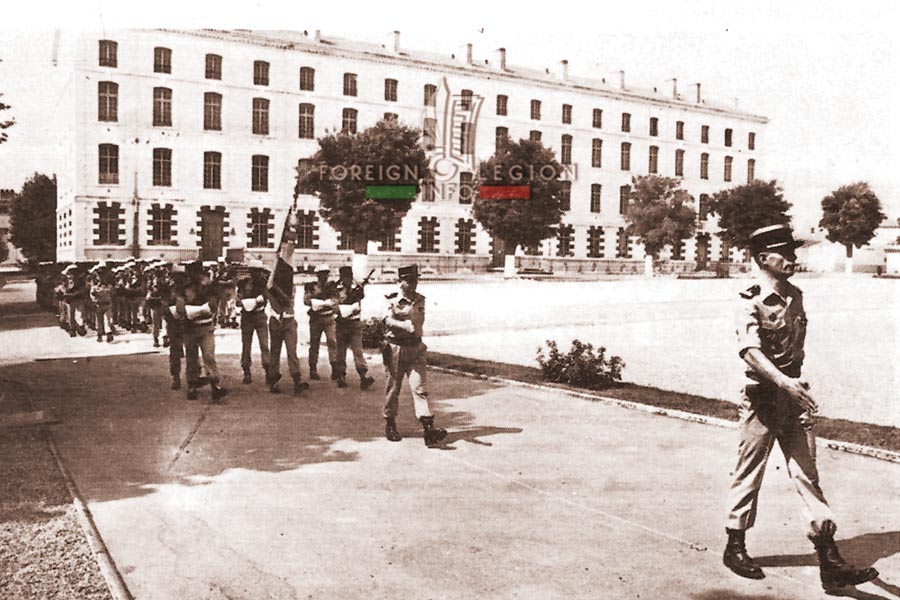
The Legion called him back in 1980. For two years he served as second-in-command of the 4th Foreign Regiment (4e RE) in Castelnaudary, the unit that turns volunteers from around the world into legionnaires. From 1985 to 1987, he commanded the 3rd Foreign Infantry Regiment (3e REI), based in Kourou, French Guiana, which operates in the equatorial jungle and protects the Guiana Space Center.
After his regimental command, Piquemal taught at the French Army’s war college in Paris and attended the country’s senior defense colleges, the Center for Higher Military Studies (CHEM) and the Institute for Higher National Defense Studies (IHEDN). From 1989 to 1992, he served on the Prime Minister’s military staff as deputy for Army affairs. He then became deputy commander for operations of the Marseille military district.
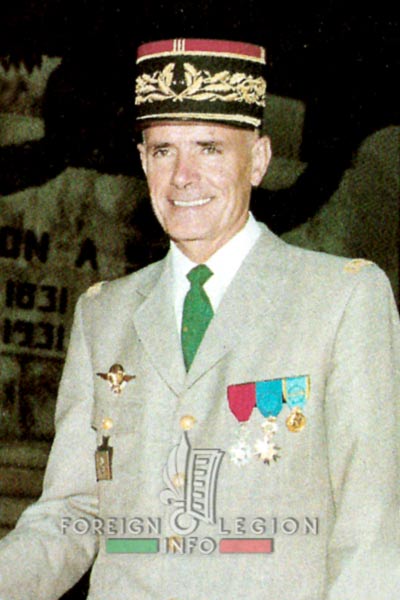
On December 1, 1994, he took command of the Foreign Legion at Aubagne. For nearly five years he was Père Légion (“Father of the Legion”), the title legionnaires traditionally give their commander. One of the lasting achievements of his command was the 2nd Foreign Engineer Regiment (2e REG), whose creation in July 1999 he did much to bring about. The new regiment became the Legion’s second engineer unit and added a specialized mountain engineering capability to its ranks.
On January 1, 1999, Piquemal attained the rank of général de corps d’armée, equivalent to lieutenant general in the U.S. (four stars in the French military system). He left the Legion and retired from active duty on September 1 of that year. His decorations included the rank of Officer of the Legion of Honor and Commander of the National Order of Merit.
Retirement did not take him far from Aubagne. He served on the Aubagne municipal council from 2001 to 2008, and from 2004 to 2014 he presided over France’s national association of military paratroopers (UNP), strengthening its regional chapters and its commemorative work. He also joined the leadership of the Fondation Général Bigeard, dedicated to preserving the legacy of one of France’s best-known airborne commanders.
In his later years the general became active in patriotic causes and took outspoken positions on immigration and national identity. After his arrest at a banned demonstration in Calais in 2016, he was acquitted in court but removed from the general officers’ reserve by presidential decree, a decision upheld by France’s Council of State in 2017.
In 2021, he was among the signatories of an open letter by retired French officers expressing concerns about national security and the country’s future, which sparked considerable public debate.
For legionnaires and veterans, however, his name will remain linked to the Legion he served at every level, from young platoon leader to its commander. He will be remembered for his strong character, his fidelity to the Legion’s traditions, and his respect for the men he led.
—
Related posts:
General Paul-Frédéric Rollet
Colonel Raphaël Vienot
General Jeannou Lacaze
General Vittorio Tresti passed away
Lieutenant Colonel Pierre Jeanpierre