
In Algeria in April 1961, a military putsch against French President Charles de Gaulle seized the city of Algiers in a matter of hours. At its core was the French Foreign Legion, the force that had helped conquer Algeria in the 1830s and had called it home ever since. Nearly every Legion unit joined. The putsch lasted four days and failed. What followed reshaped the institution for many years to come.

The Legion at the Crossroads
Algeria, French North Africa. In the early hours of April 22, 1961, the 1st Foreign Parachute Regiment (1er REP), widely considered the most combat-ready formation in the French Army at the time, left its camp and moved to Algiers, the capital. Its legionnaires had seized four strategic points across the city. Three commanding generals were captured. The only casualty was a sergeant who attempted to defend the radio station. Within hours, the putschists controlled the city.
The operation was the opening act of what became known as the Generals’ Putsch — a last-ditch attempt by four retired French generals to prevent President Charles de Gaulle from giving up Algeria. It lasted four days. And at its center, from beginning to end, stood the French Foreign Legion.
The Legion’s involvement was not incidental. Of the fourteen Legion units stationed in Algeria at the time, nearly all joined the putsch in one form or another. The 1er REP spearheaded the takeover of Algiers.
And yet the Legion’s top commander, General René Morel, did not join. He was a former member of de Gaulle’s wartime Free French Forces and firmly opposed the putsch — though he was in France at the time and had limited authority over his men. Several regimental commanders were absent, on leave, or deliberately ambiguous. Within the Legion, the putsch was driven not from the top of its hierarchy but from its middle ranks: lieutenant colonels, majors, and captains who had spent years fighting in Indochina and Algeria and who refused to accept that it had all been for nothing.
This is the story of those four days.
Why the Legion? (1946–1960)
To understand why the Foreign Legion participated in the April 1961 putsch, we have to go back fifteen years, to the jungles of Indochina.
French Indochina — today’s Vietnam, Cambodia, and Laos — had been under French rule since the 1880s. In 1946, a full-scale war broke out between France and the Viet Minh, the Vietnamese independence movement. The conflict dragged on for eight years. Tens of thousands of French soldiers died, among them thousands of legionnaires. When the ceasefire came in 1954, France had to leave. For many officers and soldiers who had fought there, the withdrawal was not a strategic decision — it was a betrayal. They were convinced the war could have been won and blamed the politicians in Paris.
The Legion’s losses in Indochina were not abstract numbers. Entire battalions had been wiped out. The men who survived carried the war with them into their next assignments. And for most of them, the next assignment was French North Africa: Algeria, Morocco, Tunisia.
Of the three, Algeria occupied a special place. It had been under French rule since the 1830s and formally part of France since 1848 — neither a colony nor a protectorate like Morocco or Tunisia, but an integral department of the republic. More than a million French settlers (Europeans of French, Spanish, Italian, and other origins, known collectively as pieds-noirs) lived there alongside the local population: Arabs, Berbers, and other Muslim communities.
And for the Legion, Algeria was home in a way no other place had ever been. The Legion had been founded in 1831 specifically to take part in the pacification of Algeria, and from that first year, it did. Legionnaires helped conquer the territory, built outposts and roads, planted trees, and shaped the land they lived on. Quartier Vienot in Sidi Bel Abbès had been the Legion’s headquarters since the 1860s. Legionnaires trained there, returned there between deployments, and many retired there. Losing Algeria didn’t just mean losing a war. It meant losing the only home the Legion had ever known.
In 1954, just as Indochina ended, a new insurgency began. The National Liberation Front (FLN) launched attacks against French forces in Algeria. By 1955, the fighting had escalated into a full war. Meanwhile, Morocco and Tunisia, countries where thousands of French soldiers and legionnaires had also died, gained independence in 1956. For many in the military, it felt like a pattern: soldiers fight, soldiers win, politicians give it away.


De Gaulle: From Savior to Target (1958–1961)
By 1958, the French Army in Algeria had had enough. On May 13, Generals Salan, Massu, Jouhaud, and Gracieux, along with civilian leaders, seized power in Algiers and formed a self-proclaimed emergency committee. General Jacques Massu, then head of the 10th Parachute Division (10e DP), became its chairman. General Raoul Salan, commander of all French forces in Algeria, assumed overall authority and announced on the radio that the Army had “taken over responsibility for the destiny of French Algeria.” Part of the coup included seizing Corsica with paratroopers flown in from Algeria. A second operation — a planned airborne assault on Paris itself and overthrowing the government — was ready to launch.
The putschists’ demand was simple: bring Charles de Gaulle back to power. De Gaulle, the wartime leader of Free France, had stepped down as head of government in 1946. Large parts of the Army and many settlers trusted him to keep Algeria French — a cause known as Algérie française. Under pressure, the government in Paris agreed. On June 1, de Gaulle was invested as Prime Minister by the National Assembly. The paratroopers stood down.
The parallel with what would happen three years later was almost exact: the same city, the same method, the same types of units, two of the four generals. The critical difference was that in 1958, de Gaulle was the beneficiary of the putsch. In 1961, he would be the target.
In June 1958, de Gaulle visited Algeria. On June 4, standing before an enormous crowd gathered in the Forum d’Alger, the city’s main square, he delivered his famous address: “I have understood you!” Two days later, in Mostaganem, he went further and shouted “Long live French Algeria!” The soldiers and settlers were jubilant.
In September, a constitutional referendum established the Fifth Republic. In Algeria, 96.6% of voters — French settlers and local Muslims alike — approved the new constitution, widely understood at the time as a vote to remain part of France. In December, de Gaulle became President. In the Army, the prevailing belief was that Algeria had been saved.
It hadn’t. Less than a year later, on September 16, 1959, de Gaulle publicly declared that Algeria had the right to self-determination. For the officers who had put him in power specifically to prevent this, the shock was enormous. In mid-1959, the French forces were closer to victory than they had ever been. The Challe Plan, a series of large-scale operations designed by General Challe, had nearly defeated the FLN across the country. And now the President was talking about letting Algeria go.
The reaction was swift. In January 1960, a German newspaper published an interview with General Massu, then-commander of French ground forces in Algiers. It was the same Massu who had led the 1958 putsch. In the interview, he called de Gaulle’s Algeria policy a mistake and suggested the Army might need to arm civilians. De Gaulle immediately removed him from command. Within days, an insurrection erupted in Algiers, led by civilian activists Pierre Lagaillarde and Joseph Ortiz, both of whom had been involved in the 1958 putsch. The so-called Week of Barricades lasted until February 1. Several military units sent to restore order, including the 1er REP, openly sympathized with the demonstrators instead.
De Gaulle responded with a television address, asking the Army to stay loyal. The barricades came down. The leaders were arrested and sentenced. But the damage was done. In September 1960, de Gaulle spoke of “Algerian Algeria” being “on the way.” In November, he used the phrase “Algerian republic” for the first time.
Yet de Gaulle remained, as President of the Republic, commander-in-chief of the French armed forces. Even as he spoke increasingly openly of Algerian self-determination — and eventually of an Algerian republic — the war itself continued. French soldiers were still being ordered into combat, still fighting the FLN, and still dying in a cause whose political end was becoming less clear by the month.
In December, de Gaulle visited Algeria and was met with massive demonstrations in favor of French Algeria. The protests were organized by the French Algeria Front (FAF), a movement claiming broad support among both settlers and Muslims. The FAF was banned within days. Meanwhile, for the first time, Algerian independence flags appeared in the streets.
On January 8, 1961, de Gaulle held a referendum on Algerian self-determination. In Algeria, 70% voted in favor. That same day, four company commanders of the 1er REP, stationed along the Tunisian border, refused to carry out a military operation. Their refusal was a protest against the referendum, and against what they saw as the absurdity of sending men into combat for a cause Paris was already preparing to abandon. Even so, it was a highly unusual act of defiance within the otherwise rigidly disciplined Legion — essentially a mutiny. The officers were quickly transferred out. Others would follow.
For the men who had fought in Indochina and watched France leave, who had fought in Algeria and believed, from what they saw on the ground, that they were winning, who had put de Gaulle in power to save French Algeria and now watched him dismantle it — the question was no longer whether to act, but when.



The Legion’s Conspirators (January–April 1961)
The answer came sooner than most expected. The 1er REP officers’ revolt on January 8 was a crack in the wall: visible, unmistakable, but still contained. Behind the scenes, a much broader conspiracy was already taking shape.
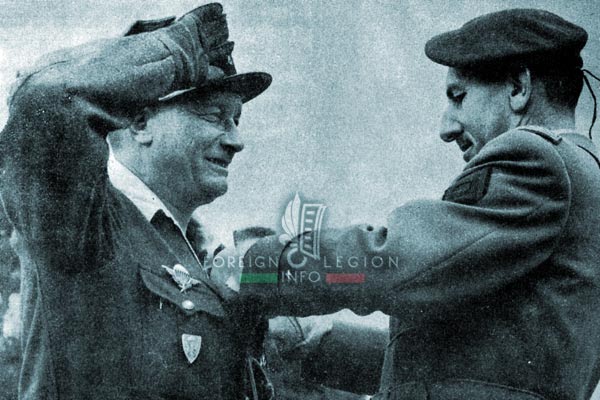
In Paris, a group of high-ranking officers had begun planning a new putsch as early as January 1961. The effort was led by Colonels Broizat and Argoud, neither of them legionnaires. However, the network they built reached deep into the Legion.
Among the key figures they recruited was Lieutenant Colonel Charles de La Chapelle, commanding officer of the 1st Foreign Cavalry Regiment (1er REC) since mid-1960 — a career cavalry officer who had served with the regiment since 1941 and fought with it through Tunisia, France, and Germany.
Another early recruit was Colonel Albert Brothier, commanding officer of the 1st Foreign Regiment (1er RE) in Sidi Bel Abbès, the administrative headquarters of the entire Legion. His support was strategically important. He had been cooperating with the plotters since January 1961. His commitment, however, would prove unreliable.
The conspiracy also counted on Lieutenant Colonel Georges Masselot, a career Legion officer who had commanded Legion airborne units in Algeria and Indochina. He now led the 18th Chasseurs Parachute Regiment (18e RCP), a non-Legion parachute unit, still with the instincts of a career legionnaire.
Then there was Major Georges Robin, who commanded the Parachute Commando Group – General Reserve (GCP-RG), an elite, battalion-sized airborne unit. A former officer of the 1er REP, Robin had spent nearly a decade in the Legion. His unit’s headquarters occupying a villa at Les Tagarins, a district of Algiers, would become the nerve center of the putsch.
The most senior Legion figure in the conspiracy was General Paul Gardy. Born in 1901, Gardy had spent his entire career in and around the Legion: from the 1er REC in Syria in the 1920s, through command of the Legion’s headquarters in Sidi Bel Abbès in the 1950s, to his final posting as commander of the Foreign Legion in 1958–60. By 1961, he was retired and part of the plot. No one in the conspiracy had stronger ties to the Legion than Gardy.
While the plotters organized, events in Algeria accelerated. In March 1961, the French government opened talks with the FLN rebels — the very enemy the Army had spent seven years fighting. On April 11, de Gaulle publicly stated that France would not oppose an independent Algeria. The next day, April 12, the plotters made their decision: the putsch would go ahead.


The Generals Arrive (April 20–21)
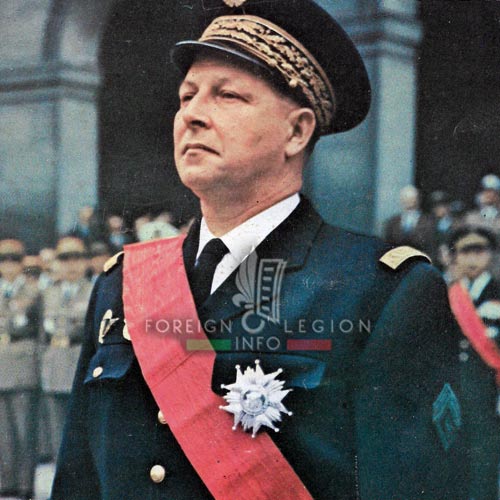
On Thursday, April 20, General Maurice Challe arrived secretly in Algeria. Architect of the successful Challe Plan, he was fifty-five years old, a career officer who had served as commander of all French forces in Algeria in 1958–60. After leaving Algeria, he had been appointed NATO commander for Central Europe, but resigned in late January 1961. He had made his choice.
Challe was accompanied by General André Zeller, sixty-three, who had twice served as commander of the French Army: in 1955–56 and again in 1958–59. Both were met on arrival by Major Robin, who brought them to his villa at Les Tagarins. The GCP-RG headquarters would now serve as the putsch’s command post.
General Edmond Jouhaud was also present; a man whose connection to Algeria was deeply personal. Jouhaud had been born there, in 1905. A career Air Force officer, he had commanded air operations in Indochina and served as deputy commander of all French forces in Algeria before rising to lead the entire French Air Force in 1958–60. He resigned in 1960. Like Challe, like Zeller, he had crossed the line from dissent to conspiracy.
Challe would lead the operation. The three generals were now assembled in Algiers. The fourth of the main plotters, General Raoul Salan, who had already participated in the May 1958 putsch, along with General Jouhaud, was expected to arrive within days.
Throughout the day, other officers filtered into Algiers, including Colonel Broizat, one of the two original conspirators. The former commander of the Legion, General Gardy, also arrived.
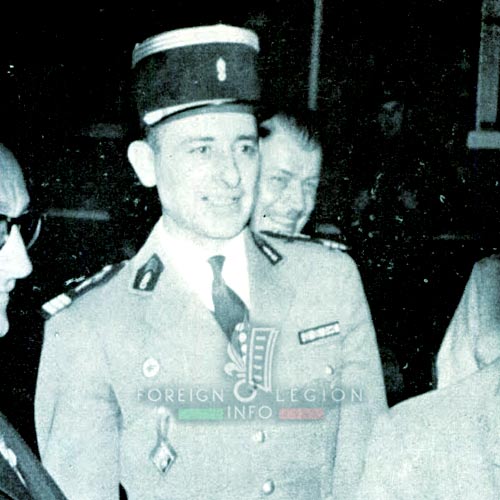
The critical moment came on Friday, April 21, at 1:30 PM (13.30). Major Hélie de Saint Marc came to see General Challe at the Les Tagarins villa. De Saint Marc, the deputy commander of the 1er REP, was serving as the regiment’s acting commanding officer because his superior — Colonel Maurice Guiraud — was on official leave. De Saint Marc had not been part of the original conspiracy. Now he was being asked to commit his elite unit to the putsch.
Challe assured him directly. This was, he said, “neither a Fascist coup d’état nor a racist action.” It was about keeping France’s word to the soldiers who had fought and died, and to the local people who had voted to remain part of France.
De Saint Marc agreed. With that decision, the 1er REP — the unit that had broken ranks during the Week of Barricades in January 1960 by siding with demonstrators rather than dispersing them, the unit whose officers had mutinied along the Tunisian border just three months earlier — became the spearhead of the putsch.
That evening, tasks were assigned. The start was set for 2:00 AM.


Taking Algiers (April 22, Morning)
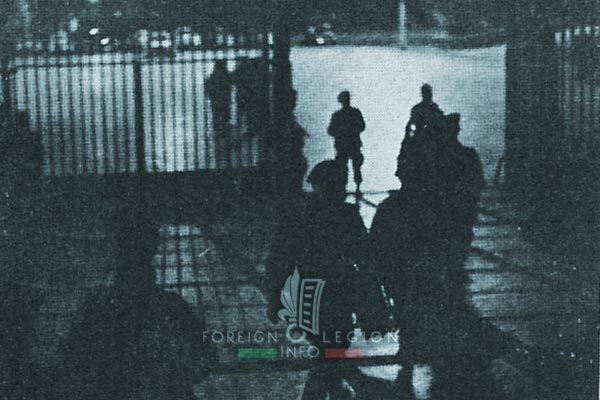
Five minutes past midnight, the 1er REP left its camp at Zeralda. The regiment moved east toward Algiers, tasked with seizing four strategic points across the city.
The first target was Caserne Pélissier, the French military barracks that served as the headquarters of French forces in Algiers. The legionnaires took it quickly. The commander of those forces in the capital, General Vézinet, was captured.
The second was the Ouled Fayet radio station. Here, the putsch claimed its only casualty. Sergeant Brillant, a French soldier on guard duty, resisted and was killed. Within five minutes, the station was in the hands of the 1er REP. The rest of the garrison offered no resistance.
The third target, the Hussein Dey Police Academy, was seized without complications.
The fourth — and most important — was the Government-General building on the Forum d’Alger, then serving as the French government’s headquarters in Algeria. Two senior officers were captured there: General Gambiez, commander of all French forces in Algeria, and General Saint-Hillier, commander of the 10th Parachute Division. As it happened, both generals were former officers of the Foreign Legion and had no interest in resisting.
By 3:30 AM, all four objectives were secure. Major de Saint Marc reported to General Challe: the mission was accomplished.
And the 1er REP had not acted alone. While the legionnaires took the four main targets, two parachute commando units swept through the rest of the city. Major Robin’s GCP-RG and the Air Parachute Commando Group (GCPA) of Lieutenant Colonel Maurice Emery seized fifteen additional points. By dawn, nineteen strategic locations across Algiers were under putschist control.
In the morning, the captured radio station served its purpose. Radio France broadcast a speech by General Challe:
Officers, Non-Commissioned Officers, Gendarmes, Soldiers, Sailors, Airmen of the Armed Forces of Algeria. This is General Challe speaking:
I am in Algiers with Generals Zeller and Jouhaud, and in contact with General Salan, to honor our oath — the army’s oath to keep Algeria French, so that our dead shall not have died in vain.
A government of abandonment has successively proclaimed French Algeria, Algeria within France, Algerian Algeria, and an independent Algeria associated with France. Today it is preparing to hand Algeria over once and for all to the external organization of the rebellion.
Would you renounce your promises, abandon our Muslim and European brothers, abandon our officers, our soldiers, and our Muslim auxiliaries to the revenge of the rebels? Do you want Mers-El-Kébir and Algiers to become Soviet bases tomorrow? Do you want, once more — for the last time — to lower your flag? If so, you will have lost everything, even your honor. […]
Throughout the day, government officials were arrested. Among them were Jean Morin, the French governor of Algeria, and Robert Buron, the Minister of Transport. They were flown to In Salah, a small town deep in the Sahara, and held in a hotel there.
Algiers was in the hands of the putschists. The operation had been fast, nearly bloodless, and executed with precision.
The 1er REC Arrives (April 22, Afternoon)
While the 1er REP held Algiers, reinforcements were on their way from the Constantine region in eastern Algeria. Three units — one Legion, two parachute — were converging on the capital.
The first to arrive was the 1er REC, led by Lieutenant Colonel de La Chapelle, one of the earliest and most committed Legion conspirators. Riding with the regiment was Colonel Argoud, one of the two architects of the entire plot and a close friend of de La Chapelle. Argoud had flown into Algeria the day before and linked up with the cavalry unit for the drive west.
Behind the 1er REC came two regiments of the 25th Parachute Division: the 14th Chasseurs Parachute Regiment (14e RCP) under Lieutenant Colonel Pierre Lecomte, and the 18th Chasseurs Parachute Regiment (18e RCP) under Lieutenant Colonel Masselot, the career Legion officer now commanding a non-Legion unit.
The three regiments arrived in the capital in the afternoon. Large crowds filled the streets to cheer them. The people of Algiers — French settlers and the local Muslim population who supported French Algeria — welcomed the legionnaires and paratroopers as liberators.


The Isolated Capital
But the enthusiasm in the capital masked a deepening problem in the rest of the country. General Challe had expected the regional commanders to follow his lead. They did not.
The Constantine region in the northeast was the most important military zone in Algeria and the one the reinforcements for the putsch had just left. Its regional commander, General Gouraud, had initially agreed to support the putsch. But on the morning of April 22, he informed Challe that he had changed his mind. The three units — 1er REC, 14e RCP, 18e RCP — were already on the road to Algiers and could not turn back to stabilize the region. A few hours later, Gouraud officially ordered his remaining troops not to join the putsch. General Zeller immediately left Algiers to try to bring Gouraud back into the fold.
In the Kabylie region, between Algiers and Constantine, General Simon refused to join. He was a former Foreign Legion colonel and a member of de Gaulle’s Free French. In the Oran region of northwestern Algeria, General de Pouilly also refused. In the western Sahara, General de Maison Rouge stayed out as well. In the South — the largest military region, covering southern Algeria and the deep Sahara — General Arfouilloux hesitated. General Challe offered him a prestigious position: commander of French forces in Algiers. But General Olié, a former colonel in the Foreign Legion who had been freshly appointed by de Gaulle as the new commander of all French forces in Algeria, made the same offer. Arfouilloux sided with Paris.
Challe now controlled Algiers and had several elite units at his disposal. But the four regional commands that surrounded the capital — Constantine, Kabylie, Oran, and the South — were either hostile or uncommitted. The putschists controlled an isolated area.
This made the Oran region critical. Northwestern Algeria was the homeland of the Foreign Legion. Sidi Bel Abbès was there. The Legion’s headquarters, its training bases, its institutional heart — all of it was in the Oran region. If General Gardy could bring that region into the putsch, the balance of force might still shift. It was, in all likelihood, the second most important action of the entire putsch after the seizure of Algiers itself.
Gardy had left for the Oran region early on the morning of April 22. He landed at the military airport of Sidi Bel Abbès where he met Colonel Brothier, the commanding officer of the 1st Foreign Regiment. Brothier had been cooperating with the plotters since January. But when Gardy arrived, Brothier’s resolve was already crumbling. He had officially placed himself on leave — on paper, at least. He claimed he was still pro-putschist, but said the Legion should wait for the regional commander, General de Pouilly, to make his decision first.
Gardy moved to Quartier Vienot, the Legion’s historic headquarters, where he met with Colonel Étienne Ogier de Baulny, a Legion cavalry veteran and Brothier’s deputy, who openly supported the putsch. According to Gardy, the rest of the 1er RE was ready. Officers were enthusiastic. Four companies were placed on alert.
But Brothier’s hesitation was a warning sign. Gardy left Quartier Vienot and drove to the city of Oran to meet General de Pouilly face to face. De Pouilly listened, but asked for time to decide. At 1:00 PM (13.00), Gardy returned to Sidi Bel Abbès, where Colonel Argoud had just arrived from Algiers. Argoud and Brothier then drove together to Oran for a final answer.
They came back with bad news. General de Pouilly would not join the putsch. He had spoken with Challe by telephone and agreed to be replaced by Gardy. The handover was scheduled for the following morning.
In practice, however, this proved only a partial solution. Gardy would get nominal command of the Oran region, but without de Pouilly’s endorsement, the officers and units under his authority had no clear reason to follow.


The Legion Revolts (April 22–23)
On Saturday, the putsch became a Legion affair. Across Algeria, one unit after another made its choice — not on orders from the Legion’s high command, which never joined, but through decisions made by deputy commanders, majors, and captains on the ground.
The most dramatic move came from the 2nd Foreign Parachute Regiment (2e REP), based at Philippeville, a port city on the eastern coast, in the Constantine region. Its commanding officer, Colonel Pierre Darmuzai, was a complex figure. A former member of de Gaulle’s Free French Forces, he was the only officer in Legion history to have commanded all three of the Legion’s main airborne units: the 1st Foreign Parachute Battalion (1er BEP), the 2e REP, and the 3e REP. On the evening of April 22, before leaving for his quarters in the garrison town, he told his officers that he understood the putschists’ position. But he asked them to wait, to stay disciplined. The next day, he said, they would be given a free choice to pick a side. His officers did not wait. During the night, while Darmuzai slept, Major Bernard Cabiro — the regiment’s deputy commander and another career Legion officer — led the 2e REP out of its base and toward Algiers.
At the 13th Foreign Legion Demi-Brigade (13e DBLE), events took an even more unusual turn. The 13e DBLE had been the first military unit to side with de Gaulle in 1940 and helped form the Free French Forces. In 1961, the situation was different. The then-commanding officer of the demi-brigade, Colonel Albéric Vaillant, was fiercely loyal to de Gaulle. As a young lieutenant in 1943, he had deserted from the Legion to join the Free French. And he made it absolutely clear that the 13e DBLE would not join the putsch. His officers saw it differently. Led by Major Jacques Gendron, one of the two battalion commanders of the demi-brigade at the time, they revolted and declared allegiance to Challe. Among the most active supporters were Captains Moulinier, Pochard, and Fourticq-Esqueoute, Lieutenants Balais and Charlet, and Lieutenant Dimke, a German legionnaire with more than fifteen years of service.
Across the rest of the Legion, the pattern repeated with less drama but equal conviction. At the 5th Foreign Infantry Regiment (5e REI), the commanding officer — Colonel Pfirrmann — initially supported the putsch. He drove to Sidi Bel Abbès on April 22 to coordinate with the plotters, but soon stepped back and adopted a neutral stance. Command fell to Major Julien Camelin, a strongly pro-putschist officer who had been in the Legion since 1945. As one company commander later put it: “Major Camelin maintained the regiment’s cohesion” throughout the events. Camelin led five companies of the 5e REI to capture General Ginestet, commander of the South Oran region, who was to be replaced by Colonel Pfirrmann.
The 2nd Foreign Infantry Regiment (2e REI) also joined, though with less fanfare. Its commanding officer, Colonel Bertrand de Sèze, was openly for French Algeria but happened to be on official leave in France. The regiment was led by Major Charles-Marie Met, the son of the legendary Legion commander, Colonel Met. His companies secured Aïn Séfra, the regiment’s garrison town in the Oran region.
At the 4th Foreign Infantry Regiment (4e REI), the situation was more ambiguous. Colonel Étienne Georgeon, the commanding officer, was a committed supporter of the putsch and an officer with a distinguished record. He had fought with Legion units in Syria, Tunisia, France, and Germany, commanded the 6th Foreign Infantry Regiment (6e REI) during its final years, and led the Legion’s Training Group before taking over the 4e REI in 1959. Georgeon made his position clear to his staff: he was joining the putsch. But he let each officer make his own free choice. His deputy, Lieutenant Colonel Michel Vadot, chose not to join. Unlike the other anti-putschists, he wasn’t a former Free French member. He simply didn’t believe the putsch would succeed. Among the most active supporters in the regiment was Captain Roquefeuil, who maintained communications between the 4e REI and the putschist command. He was arrested after the putsch but eventually acquitted.
The 2nd Foreign Cavalry Regiment (2e REC) joined under its commanding officer, Lieutenant Colonel Charles de Coatgoureden, who was an active pro-putschist. He followed the lead of the regiment’s previous commander, Lieutenant Colonel de Baulny, who was now the deputy commander of the 1er RE in Sidi Bel Abbès and an ardent supporter of the coup.
Even the Foreign Legion’s Saharan motorized units were drawn in. Four such units were stationed across the southern reaches of Algeria. According to General Gardy, the majority joined the putsch, meaning at least three of the four. Among them was the 1st Legion Saharan Motorized Squadron (1er ESPL), commanded by Captain Jacques Gaud. A former squadron commander of the 1er REC, Gaud had taken over the unit only in mid-February 1961. His squadron is said to have guarded the government officials held at In Salah.
By Sunday morning, the extent of Legion involvement had become difficult to ignore. The 1er REP, 2e REP, 1er REC, 2e REC, 1er RE, 2e REI, 5e REI, 13e DBLE, most of the Saharan units, and even the 4e REI — to varying degrees — had joined the putsch. The only clear holdout was the 3rd Foreign Infantry Regiment (3e REI). Its commanding officer, Colonel Pierre Langlois, was another former member of the Free French. He refused categorically to support any action against de Gaulle. No accessible records indicate any pro-putschist activity within his unit.
The Legion’s top commander, General René Morel — also a former Free French officer and strongly anti-putschist, was in France and had little authority over events on the ground in North Africa. There, the putsch was being run by the operational core of the Legion: the officers who lived among legionnaires, led them in the field, and decided, one by one, that they could not stand aside.




The Turning Point (April 23)
On Sunday afternoon, April 23, the last of the four generals arrived. General Salan flew into Algiers from exile in Spain. He was widely regarded at the time as the most decorated officer in the French Army — a veteran of both World Wars who had commanded French forces in Indochina and Algeria and led the 1958 putsch that brought de Gaulle to power. After retiring in 1960 and publicly supporting French Algeria, he had escaped arrest and fled to Spain. Now he was back. With him came two civilian activists: Jean-Jacques Susini and Joseph Ortiz. They had organized the Week of Barricades in 1960, been sentenced to prison, escaped to Spain, and returned to organize civilian support.
The putschists were now at full strength: four generals, a network of Legion and parachute units, and enthusiastic crowds in Algiers. But beyond the capital, the rest of French Algeria was not following. And that evening, a voice from Paris would make sure it stayed that way.
At 8:00 PM (20.00), President de Gaulle appeared on French television. He put on his brigadier general’s uniform and spoke directly into the camera.
The speech was short, barely five minutes, and delivered in a tone of controlled fury. He called the putsch “an enterprise of usurpers” led by “a quartet of retired generals.” He described their action as “insurrection” and declared a state of emergency under Article 16 of the Constitution, giving himself full executive and legislative powers. Then he turned to the soldiers in Algeria. He ordered — not asked, ordered — every French soldier to disobey the putschists. No soldier, he said, was bound to follow orders given by men who had placed themselves outside the law.
The putschists were keenly aware of more than one parallel. In May 1958, a similar putsch in Algiers had helped bring de Gaulle back to power by rebelling against the existing government in Paris. Salan and Jouhaud, two of the “quartet of retired generals,” had both been involved. And in June 1940, when the French government negotiated a truce with the enemy, it was de Gaulle who had placed himself outside the law by urging the French to disobey and ignore official authorities, by insisting that the struggle must not be abandoned, that it must continue until final victory. Now, when that same spirit of disobedience was directed against him — because he himself was now seeking terms with the enemy and preparing to abandon part of France — de Gaulle invoked the law and condemned any defiance. For the officers who had grown up on the legend of June 18 — de Gaulle’s 1940 radio appeal from London — and for those who had helped bring him back to power in May 1958, the irony was bitter.
But in the end, the practical effect of his April 23 speech mattered more than its irony. Across Algeria, hundreds of thousands of conscripts — young men serving their mandatory military service, with no career stake in Algeria — heard the speech on their transistor radios, tuned to French metropolitan broadcasts that the putschists could not control. The effect was immediate. On bases controlled by putschist officers and on bases that had stayed neutral, conscripts stopped working, stopped obeying, and in many cases simply sat down. They were not legionnaires. They were not paratroopers. They were ordinary soldiers who had heard their President tell them the putsch was illegal, and they acted accordingly. Since conscripts formed the backbone of most French units in Algeria, their refusal was crippling.
Officers wavered too. Many who had quietly supported the putsch or adopted a wait-and-see posture now began to pull back. De Gaulle’s speech forced a binary choice — and for officers with careers, pensions, and families to consider, the calculus shifted overnight. The putschists’ inaction made it worse. After the swift seizure of Algiers on Saturday morning, no second move had come. No march on Oran. No push into Constantine. The putsch held the capital and a handful of committed units, and it was not expanding.

Losing Ground (April 24)
On Monday, April 24, General Gardy moved to salvage the situation in the Oran region. He sent the 14e RCP and 18e RCP to Tlemcen, a town southwest of Sidi Bel Abbès, where General de Pouilly — removed from command but not arrested — had been attempting a small counter-rebellion of his own, encouraged by Paris. The two regiments formed a brigade under Lieutenant Colonel Masselot. In Tlemcen, Masselot spoke with de Pouilly personally. The two men knew each other, and Masselot had no desire to arrest him. De Pouilly asked to speak with Challe. A military helicopter took him to Algiers, where the two generals had a long conversation. De Pouilly refused to join. He was arrested and sent to In Salah in the Sahara where the other detained officials were being held under guard by the 1er ESPL legionnaires.
That same day, Colonel Georges de Boissieu, commander of the Djidjelli sector in the Constantine region, formally joined the putsch. De Boissieu was himself a career Legion officer who had served with Legion units across North Africa and commanded the 5e REI in Indochina. His joining changed nothing militarily. It was a symbolic act more than a strategic one. A gesture of personal loyalty to General Challe, under whom he had previously served as a staff officer.
At 6:30 PM (18.30) on Monday, the four generals — Challe, Zeller, Jouhaud, and Salan — appeared together at the Forum d’Alger for a public speech. An estimated one hundred thousand civilians filled the square. The crowd cheered the generals as their last hope for French Algeria. The demonstration was guarded by the 1er REP, the same unit that had seized the city two days earlier and that now stood watch over what would be the putsch’s final public moment.
But behind the spectacle, the structure was collapsing.
Earlier that day, several actions had been launched to restore order at rebellious military bases around Algiers. A company of the 1er REP was sent to Caserne d’Orléans in the city. Squadrons of the 1er REC, followed by 1er REP units, moved to the military air base at Blida, southwest of the capital. The 2e REP was dispatched to Maison Blanche, the capital’s airport. These were attempts to hold together a perimeter that was already fraying.
The most damaging episode came at Mers El Kebir, the French naval base northwest of Oran and the most important military installation in North Africa. Admiral Querville, the base commander, had initially promised General Gardy he would remain neutral. He now broke that promise and refused to cooperate. General Challe ordered the base seized. Gardy sent the 14e RCP.
This episode marked one of the clearest signs that the putsch was breaking down. When Lieutenant Colonel Lecomte’s 14e RCP arrived at Mers El Kebir, two of his three companies refused to carry out the order. The conscripts simply would not move against the naval base. The operation was abandoned. The most important military installation in the region stayed out of the putschists’ hands.
And in Sidi Bel Abbès, Colonel Brothier, who had cooperated with the plotters since January and played both sides for three days, finally broke with the putsch for good. He refused to send any Legion units from the 1er RE to Mers El Kebir. With that, Brothier’s earlier ambiguity was over.
Monday night, the putsch still technically held Algiers. The four generals had spoken to a cheering crowd. The Legion units still controlled the city. But everywhere else the ground had given way.


Collapse (April 25)
On Tuesday morning, General Gardy called General Challe from Oran. The news was bad on every front. The 14e RCP had fractured at Mers El Kebir; the naval base remained out of reach. Colonel Brothier had cut off the 1er RE. The Oran region — the Legion’s homeland — was lost.
Challe told him to come back to Algiers. The 14e RCP and 18e RCP were to withdraw from the region as well.
In the afternoon, the 1er REC and the 2e REP pulled out of Algiers, heading east toward the Constantine region. Their departure confirmed the end.
That evening, General Challe capitulated.
He had launched the putsch expecting that most of the French forces in Algeria would rally behind him. The seizure of Algiers had been flawless. But beyond the capital, the putsch never gained ground. The regional commanders refused one after another. The conscripts stopped obeying. De Gaulle’s television speech turned the weight of the state and public opinion against the plotters. And in the end, even units that had joined began to crack.
Challe stated his reason simply: he did not want to see French soldiers fighting each other. The putsch had been launched to keep a promise: the promise that the sacrifices in Algeria would not be in vain. Starting a civil war within the Army would have been the ultimate betrayal of that principle.
Generals Zeller and Gardy disappeared. They would not be seen for some time. Zeller would surrender two weeks later; Gardy never surrendered.
Generals Challe, Salan, and Jouhaud left the capital together. They drove to the 1er REP’s camp at Zeralda — the same camp the regiment had left four days earlier, in the night, to seize the city. It was the last place the putsch had a roof.
In the early hours of Wednesday morning, April 26, Salan and Jouhaud slipped out of the camp. Both chose to continue the fight for French Algeria.
General Challe stayed at Zeralda. When morning came, he was arrested.
The putsch had lasted four days. It was over.



The Price
The retribution was swift. On April 30, the Legion’s most sacred day (Camerone Day, honoring the legendary Battle of Camerone), the French government dissolved several units that had actively participated in the putsch. The list read like a roll call of the Army’s elite.
The 1st Foreign Parachute Regiment was disbanded. The unit that had spearheaded the seizure of Algiers ceased to exist. It had been the putsch’s most committed unit from beginning to end.
Gone too were the two Chasseurs Parachute Regiments: the 14e RCP and 18e RCP that had driven to Algiers on Saturday, then to Oran and Tlemcen. Major Robin’s Parachute Commando Group, which had seized additional targets on the first night, was dissolved. So was the Air Parachute Commando Group of Lieutenant Colonel Emery. And both the 10th Parachute Division and the 25th Parachute Division — the parent formations of most of these units — were struck from the French order of battle. In a single decree, the French Army lost several of its most capable and experienced formations.
Across Algeria, roughly 220 officers were removed from command. More than 110 were arrested. The trials began in June 1961 in Paris.
Among the higher-ranking officers outside the Legion, five active generals were convicted. General Bigot received fifteen years. General Nicot got twelve. General Faure received ten. General Petit got five. General Mentré was acquitted. General Gouraud — the commander of the Constantine region who had joined the putsch, then left, then rejoined, then left again — was arrested despite having officially ordered his troops not to participate. He was sentenced to seven years. His case was, by any measure, the most paradoxical of the entire affair.
The four generals who had led the putsch received the harshest sentences. General Challe was sentenced to fifteen years in prison. General Zeller, who surrendered in early May after two weeks on the run, also received fifteen years. They were freed in December 1966 and pardoned by de Gaulle in 1968. Both died in 1979.
General Salan and General Jouhaud did not surrender. After leaving the 1er REP’s camp at Zeralda, the two generals chose to continue the fight for French Algeria underground. They became leaders of the Secret Army Organization (OAS), a clandestine paramilitary organization that operated in Algeria and metropolitan France. Jouhaud was arrested in March 1962. Salan was caught a month later. Both were sentenced to death. Both sentences were later commuted to life imprisonment. Jouhaud was freed in December 1967, Salan in 1968. Both were pardoned by de Gaulle in 1968 and fully rehabilitated in 1982. Jouhaud died in 1995 at the age of ninety. Salan died in 1984.
General Gardy was never caught. After the putsch, he also went underground and carried on within the OAS. In June 1962, shortly before Algeria became independent, he left for South America. He was sentenced to death in absentia. Gardy died in exile in Argentina in 1975.
The officers who had driven the putsch on the ground paid their own price.
Major Hélie de Saint Marc, who had committed the 1er REP to the putsch, was sentenced to ten years in prison. He was freed in December 1966, pardoned in 1968, and fully rehabilitated in 1982. He died in 2013.
The three lieutenant colonels who had led regiments into the putsch received similar sentences. Charles de La Chapelle, the commander of the 1er REC and one of the earliest conspirators, was given seven years. Georges Masselot, the career Legion officer who led the 18e RCP and the Tlemcen brigade, received eight. So did Pierre Lecomte of the 14e RCP, the regiment that had fractured at Mers El Kebir. All three were freed by 1966, pardoned in 1968, and rehabilitated in 1982. De La Chapelle died in 2000, Masselot in 2002.
Major Georges Robin from the GCP-RG was sentenced to six years. Freed in July 1965, pardoned in 1968, rehabilitated in 1982. He died in 2007.
Others received lighter sentences. Lieutenant Colonel Maurice Emery of the GCPA was given three years, suspended. Major Julien Camelin of the 5e REI, who had held his regiment together and neutralized a regional general, also received three years, suspended. Major Bernard Cabiro of the 2e REP — the man who led the regiment to Algiers while his commanding officer slept — was sentenced to one year, suspended.
The majority of the remaining arrested officers received sentences of one to five years, most of them suspended. Several lower-ranking officers were acquitted.
Colonel Brothier, commanding officer of the 1er RE, navigated the aftermath as he had navigated the putsch itself: on both sides of the line. Weeks later, testifying in court, he spoke out against the Putsch, to the astonishment of his own officers. In the summer of 1961, Brothier was replaced at the 1er RE by Colonel Vaillant — the loyal Gaullist from the 13e DBLE who had been removed from command by his own subordinates during the putsch. Brothier retired as a general and died in 2005.
Colonel Georgeon of the 4e REI, who had joined the putsch but given his officers the freedom to choose, was replaced in early May by his deputy, Lieutenant Colonel Vadot — the man who had stayed out because he didn’t believe the putsch would succeed. Georgeon retired as a general and died in 1974.
Captain Gaud of the 1st Legion Saharan Motorized Squadron, whose men had guarded the detained officials at In Salah, was immediately removed from command.
At the 13e DBLE, where the officers had revolted against their anti-putschist colonel and declared allegiance to Challe, the reckoning was broad. According to an open letter by one of the 13e DBLE officers, the majority of them were arrested.
Colonel Darmuzai, the 2e REP’s commanding officer who had been asleep when his regiment left for Algiers, testified in court that the unit’s departure was “a betrayal.” He added that “such a unit should not survive.” This remark permanently damaged his standing within Legion circles. Darmuzai left the institution for good and never again appeared at any official Legion event. As for the 2e REP, the regiment survived. Thanks largely to its successful engagements in Chad in 1969, in Loyada in 1976, and in Kolwezi in 1978, it went on to become the best-known and most elite regiment in the French Army — effectively inheriting the place once held by its disbanded sister unit, the 1er REP.


Conclusion
The Generals’ Putsch in Algiers failed largely because it never spread beyond the capital and a handful of committed units. A key reason was that many of the generals had served in de Gaulle’s Free French Forces during World War II and remained loyal to him. Within the Legion itself, the divide between ardent Gaullists and the rest of the officer corps was especially sharp.
For most of the legionnaires and their officers who participated in the putsch, the driving force was not political ideology or personal ambition. They acted because they believed a promise had been made — to them, to their dead, and to the people of Algeria who had voted to remain French — and that the promise was being broken. They were wrong about what they could achieve. But they were not wrong about what would follow.
In April 1961, nearly every Legion unit in Algeria joined the putsch. The aftermath — disbandments, arrests, trials — left scars that shaped the Legion’s internal culture for many years to come. Dozens of battle-hardened officers with a deep understanding of the Legion’s spirit were forced out. They were replaced by officers selected primarily for political loyalty. Some Legion veterans would later say that the new commanders, often drawn from metropolitan France, lacked combat experience and had little understanding of — or sympathy for — the men they now led.
The Legion was now more guarded, more deliberately apolitical, and more determined never to be drawn into revolt again.
A year later, in mid-1962, Algeria became independent. Over a million French settlers — pieds-noirs — left. Hundreds of thousands of local Muslims who had supported France (including auxiliary forces, known as Harkis) faced violent reprisals. And the Foreign Legion lost Sidi Bel Abbès. The town that had served as its headquarters for an entire century was abandoned in October 1962. Over the following years, the remaining Legion units left one by one. By early 1968, the last of them had gone. Algeria, the country the Legion had helped conquer and shape since its founding in 1831, was no longer its home. Its new headquarters was established in Aubagne, a small town near Marseille, the port through which generations of legionnaires had once sailed to North Africa.
In the end, the Foreign Legion overcame the crisis, as it always had. It once again came to be regarded as the elite of the French Army. But the land it had fought to keep was lost for good.
———

———
Main information sources:
Képi blanc magazine
Historia magazine
Historama magazine
Maurice Cottaz: Les procès du putsch d’Alger (Nouvelles Editions, 1962)
Pierre Montagnon: Histoire de la Légion (Pygmalion, 1999)
Fanion Vert et Rouge (FR ; no longer accessible online)
A.D.I.M.A.D. – Algeria 1830-1962 (FR ; no longer accessible online)
Jean J. Viala’s site – Algerian War – Chronology (FR)
———
Learn more about the Foreign Legion’s history:
Foreign Legion in the Balkans: 1915-1919
Legionnaires paratroopers in World War II
French Foreign Legion in World War II
Foreign Legion in Madagascar 1947-1951
1952 Battle of Na San
———
The page was updated on: May 16, 2026