
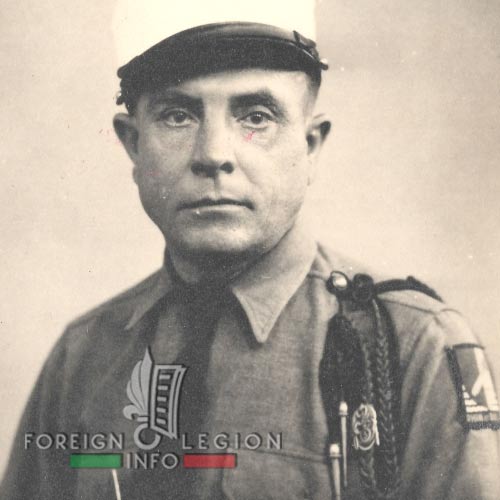
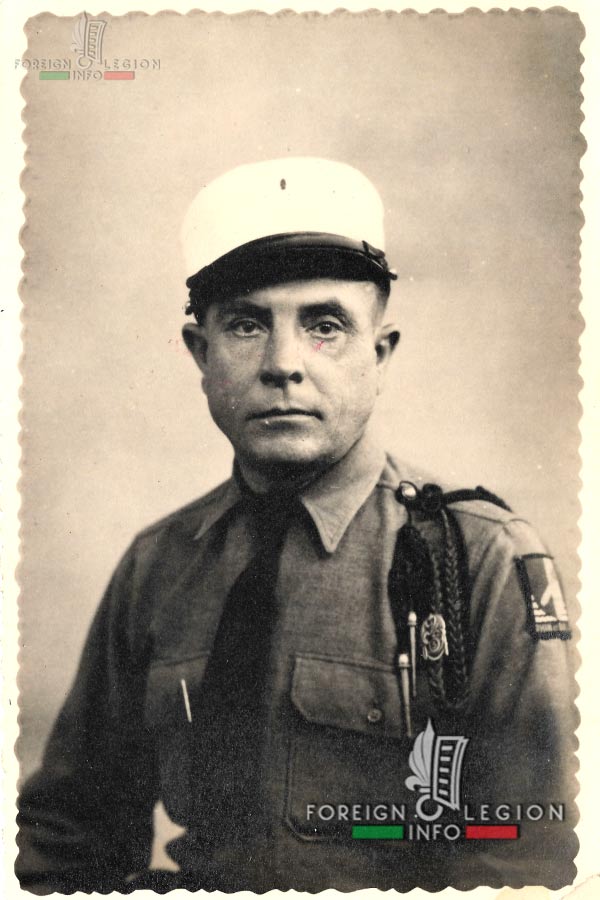
This new part of our PHOTOS series features a portrait taken in France and dated June 19, 1945. At first glance, it looks like many other wartime photographs of French Foreign Legion soldiers. Look a little closer, though, and you will find a badge that few collectors have ever seen in a period photograph. And as it turns out, the badge’s story may be quite different from the one told in official sources.
The Man in the Photograph
The photograph shows an older legionnaire of the Foreign Legion Marching Regiment (Régiment de marche de la Légion étrangère, RMLE), a provisional unit formed for wartime service. This one was created in mid-1943 by bringing together all of the Legion’s combat-ready men after its remaining infantry regiments in North Africa had been disbanded. With the RMLE, the legionnaire took part in the Liberation of France in 1944 and 1945.
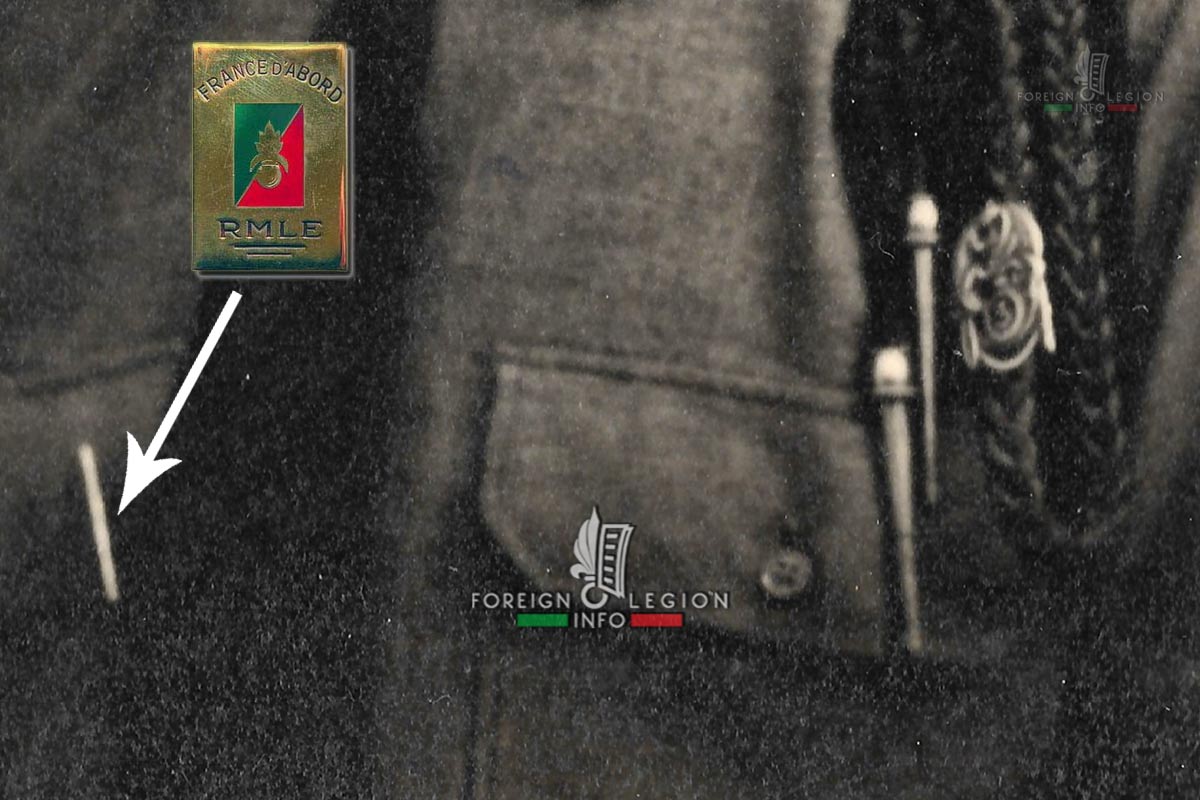
He wears the Legion’s traditional képi blanc, white kepi, and a U.S. Army Enlisted Service Shirt, Model 1937. Made of olive drab wool, it is known for its color as the “mustard shirt.” The reason is simple: by this point in the war, French forces fighting alongside the Allies were largely outfitted with American uniforms and equipment. The RMLE badge is pinned to his right breast pocket, although it is hard to make out in the photo.
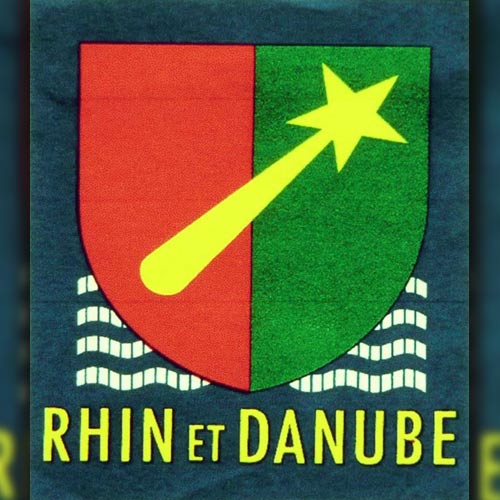
On his left sleeve is the shoulder patch of the French First Army, known as Rhin et Danube (Rhine and Danube). By coincidence, its dominant colors, green and red, are also the traditional colors of the Foreign Legion. In fact, they come from the coat of arms of Colmar, a city in Alsace near the German border. The First Army liberated Colmar in early 1945 while clearing the so-called Colmar Pocket, a German-held bridgehead on the French side of the Rhine, and the RMLE took part in that fighting. The two rivers in the name are the Rhine, which the army later crossed, and the Danube, which it reached during its advance through Germany and into Austria.
One more detail is worth noting. According to official records, 100,000 of these patches were delivered to the troops on June 18, 1945. Our photograph is dated just one day later, so the patch on his sleeve was most likely brand new.
The Double Fourragère and the Badge
The most interesting part of the photograph, however, is on his left shoulder. There he wears a fourragère, a braided cord that the French military awards as a collective decoration to an entire unit rather than to individuals. This one is the prestigious double fourragère, earned during World War I by the original RMLE (1915–1920) for nine citations in Army orders. Each such citation was a formal commendation of the whole unit for its conduct in battle. With nine of them, the RMLE ended the war as one of the most highly cited regiments in the French Army, surpassed by only one other.
In 1920, the RMLE was redesignated the 3rd Foreign Regiment, later the 3rd Foreign Infantry Regiment (3e REI). The double fourragère naturally passed to it, and the 3e REI wore it until the unit was disbanded in 1943. Because the new wartime regiment carried the same name as the original RMLE of 1915, it was granted the privilege of fighting under the 3e REI’s colors and of wearing its double fourragère.
Pinned to the fourragère is the first, original badge of the 3e REI. By wearing it, its owner proudly pointed to the regiment in which he had served before 1943. This wartime custom lasted until around 1950, when legionnaires began wearing the badges of their former units on the left shoulder board instead.
The badge is built around the Legion’s traditional seven-flame grenade, with the regimental numeral “3” inside. It also shows the double fourragère, the regiment’s source of pride. The most striking element, though, is an amphibian, which gave the badge its nickname: the “Salamander.” Why the designer chose this creature will probably never be known. One possible explanation lies in traditional French heraldry, where the salamander is a creature that can live in fire and withstand its destructive power. It may therefore have stood for the regiment’s indestructibility.
The last notable feature is the Latin motto Legio Patria Nostra (“The Legion Is Our Fatherland”). Most likely thanks to this very badge, the motto spread over time and was eventually adopted by the Legion as a whole.

The Official Version
According to the version generally accepted today, the badge was created around 1928. If so, it would be the very first badge ever made for any unit of the Foreign Legion.
The year 1928 comes from the Legion’s official magazine, Képi Blanc, in its January 1969 issue. Given when and how it was published, however, the claim does not carry much weight. At the time, the magazine’s own writers admitted that they knew almost nothing about the history of Legion insignia. They turned to their readers for help and often received contradictory answers. For the year 1928, not even a reader’s letter is on record. The information must have come from within the Legion itself, most likely from someone at Legion headquarters in Aubagne.
There is also a telling detail from only a few months earlier. In the summer of 1968, a note from the Képi Blanc editors had dated the “Salamander” badge to 1940. In other words, in half a year, the date moved back by twelve years, with no source given.
Evidence for a Later Origin
Far more revealing is a letter from Colonel Thevenon, a former commander of the 2e REI in Algeria, published in the very next issue of Képi Blanc, in February 1969. Writing about the origin of another insignia, the 1935 badge of the 3e REI’s 1st Battalion, he mentions an interesting fact. As soon as the then-regimental commander learned of the new battalion badge, he banned it outright, saying: “The 3e REI has its double fourragère. It doesn’t need a badge.” Such a remark would hardly make sense if the regiment had already been wearing a badge of its own before 1935. Thevenon, who was serving in the 3e REI at the time, added that until 1939 neither the regiment nor its battalions had any badge at all. The only exception was its Compagnie montée, a prestigious mule-mounted company that enjoyed special privileges.
The Legion itself points in the same direction today. In 2019, Legion headquarters published the Recueil des traditions et des spécificités de la Légion étrangère, an official compendium of the Legion’s traditions. Its appendix on insignia states that the first regiments to adopt a regimental badge were the 1st Foreign Cavalry Regiment (1er REC) in 1936 and the 4e REI in 1937. There is not a word about the 3e REI, or about 1928.
The maker’s mark tells a similar story. According to professional collectors, the very first 3e REI badges bore the mark Drago Paris 25 R Béranger, used by Drago, the well-known Paris insignia maker. That form of the mark, however, is typical of the late 1930s, and of 1939 and 1940 in particular, not of the late 1920s.
Finally, there are the photographs. If the badge had been worn since 1928, it would surely appear in at least some of the hundreds, if not thousands, of 1930s photographs of 3e REI legionnaires that circulate among collectors and online. The reality is quite the opposite. Andrew Mitchell, arguably the world’s leading authority on Foreign Legion insignia and the owner of a large collection of prewar photographs, told me that in his entire life he has seen only two photographs showing this badge, including the one published here. Apart from this photograph, I have seen only one other myself, and it too dates from the 1940s. Another longtime professional collector, with a very large photo archive of his own, told me that this was the first time he had ever seen the “Salamander” badge in a photograph.
The most likely explanation is that the badge was not produced until the beginning of the war. That would account for its complete absence from photographs of the 1930s. Its rarity in the years that followed is no surprise either. Photographs of Legion garrisons in North Africa from 1940 to 1945 are scarce to begin with. Finding one of the 3e REI is harder still, and finding one that actually shows this badge is close to impossible.
Conclusion
The available sources, then, do not support the year 1928. On the contrary, every piece of evidence argues against it, and most of it points to 1939–1940. The exact year cannot yet be documented, but the period can be narrowed down with reasonable confidence.
This photograph shows not only an older legionnaire still honoring the regiment he had once served in, but also one of the most rarely photographed regimental badges in the history of the French Foreign Legion. I hope that both the photo and the facts behind it will be of interest not only to those of you who collect Legion insignia, but also to anyone with an interest in the Foreign Legion and its history.
Click on the previews to enlarge them:
—
Related posts:
PHOTOS: 3e REI in Madagascar in 1965
PHOTOS: 5e RMP’s Heavy Equipment Company in Tahiti in 1971
PHOTOS: Foreign Legion Saharan Battery from 1939 to 1942
PHOTOS: 6e REI in Tunisia around 1950