
In 1943, the 3rd Foreign Infantry Regiment, one of the two most decorated regiments in the French Army, was officially disbanded. Yet in Fez, Morocco, a handful of its units lived on. They were deliberately kept in existence to preserve the continuity of a name that no one could bring themselves to let disappear. Scattered from the Middle Atlas mountains to the Saharan borderlands, armed with aging weapons and reduced to skeleton strength, these mounted and motorized companies would spend the war and the immediate postwar years in almost complete isolation, far from the battlefields of Europe and Indochina. This article tells their little-known story.
—
L'article en français : Groupement des compagnies montées et portées du 3e REI
—
Introduction
Early in World War II, in June 1940, France fell to the German armies, and part of the country came under enemy occupation. The surviving legionnaires who had been fighting in France returned to French North Africa (Algeria, Morocco, and Tunisia). Left under French administration by the Germans, the territory was then home to the Foreign Legion’s headquarters and most of its units.
At the end of 1942, the Allies landed in North Africa. After brief negotiations, the French command there joined the Allied cause and decided to take part in the coming campaign in Tunisia. The Axis forces, both German and Italian, had fallen back into Tunisia from neighboring Libya under pressure from the British and the Free French. The latter included the 13th Foreign Legion Demi-Brigade (13e DBLE), which would rejoin the Legion in 1944.
In Tunisia in 1943, Foreign Legion units saw hard fighting. Among them was the legendary 3rd Foreign Infantry Regiment (3e REI), one of the two most decorated regiments in France. The campaign ended in an Allied victory with the destruction of the last enemy resistance in Africa. Losses among the legionnaires, however, were so heavy that a complete reorganization of the Legion was ordered in mid-1943. Of the Legion’s combat units, only the 1st Foreign Cavalry Regiment (1er REC) remained in Africa. All the infantry regiments, including the 3e REI, were disbanded. Their men were brought together in a provisional regiment, the Foreign Legion Marching Regiment (RMLE), named after the famous World War I unit of the same title.
The choice of name was more than a symbolic gesture. Through official lineage, that same World War I unit had been redesignated the 3rd Foreign Regiment (3e RE) in 1920. This was one of the main reasons why the new RMLE received as its emblem the heavily decorated colors of the now officially disbanded 3e REI. It was also why its men were granted the right to wear the rare double fourragère (a braided cord worn on the left shoulder as a collective unit decoration).
Meanwhile, a curious paradox was taking shape in Fez, Morocco, the home of the 3e REI, one that was entirely deliberate. Although the 3rd Foreign Regiment had been disbanded, its regimental administrative headquarters and the units attached to it remained active and continued to carry out their duties in their Moroccan garrisons. The reason was clear. There was strong reluctance to disband such a famous regiment for good, and a wish to preserve at least some form of the unit’s legal continuity.
At that time, the 3e REI’s administrative headquarters in Fez consisted of a staff and a depot company. Several units were attached to it administratively. There were the last two mule-equipped mounted companies, once elite units that had played an important role in the pacification of Morocco and the Algerian-Moroccan borderlands. There were also three motorized companies and the little-known Foreign Legion Autonomous Artillery Group (GAAL), made up of three artillery batteries. All these units were scattered across Morocco, from the northeast to the southwest, separated by hundreds of miles and therefore enjoying a considerable degree of autonomy.
Creation of the GCMP/3e REI
This organization did not stay the same for long, however. In February 1944, the Autonomous Artillery Group was disbanded. Its legionnaires went to reinforce the units fighting in Italy or those preparing for the liberation of France.
The crucial decision came two months later, on April 22, 1944. That day, a service memorandum from the French Commissioner for War (the equivalent of the Minister of Defense) ordered the dissolution of the 3e REI’s administrative headquarters in Fez. Its remaining units were to form an autonomous group, treated administratively as a regiment. This decision led to a further reorganization of these units: the last two mounted companies were merged in late May, leaving only one, the 8th Mounted Company (8e CM).
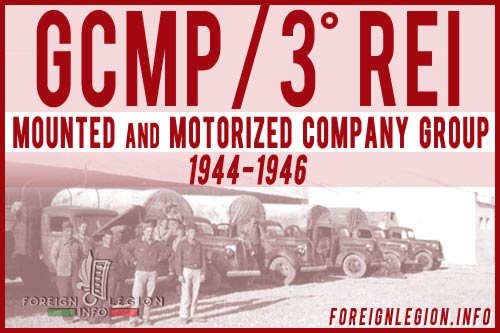
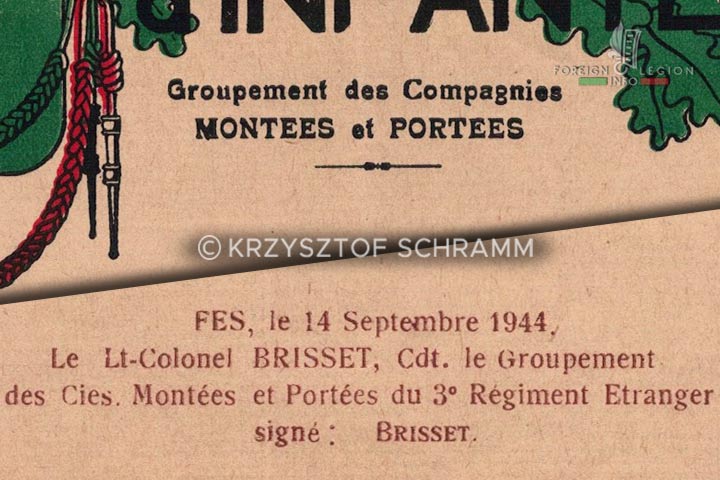
On June 1, 1944, the Mounted and Motorized Company Group, 3e REI (Groupement des compagnies montées et portées du 3e REI, GCMP/3) finally came into existence. The staff of the disbanded administrative headquarters became the staff of the new group, and the Depot Company became its HQ Company. The 8e CM and the three motorized companies comprised the group’s main units.
Lieutenant Colonel Léontin Brisset, the former commander of the 3e REI’s administrative headquarters, was appointed commanding officer of the GCMP. He was no newcomer to the Legion. In the 1930s, as a captain, he had been sent to the French Levant (Syria and Lebanon) with his legionnaires. There, in 1941, he had faced the British invasion at the head of the 2nd Battalion of the 6e REI.
Captain Maussenet was appointed as his deputy.
Administratively, the GCMP came under the Foreign Regiments Joint Depot (DCRE) at Sidi Bel Abbès, Algeria, which was then the Legion’s headquarters. Operationally, however, each company remained autonomous and answered to its local regional command.
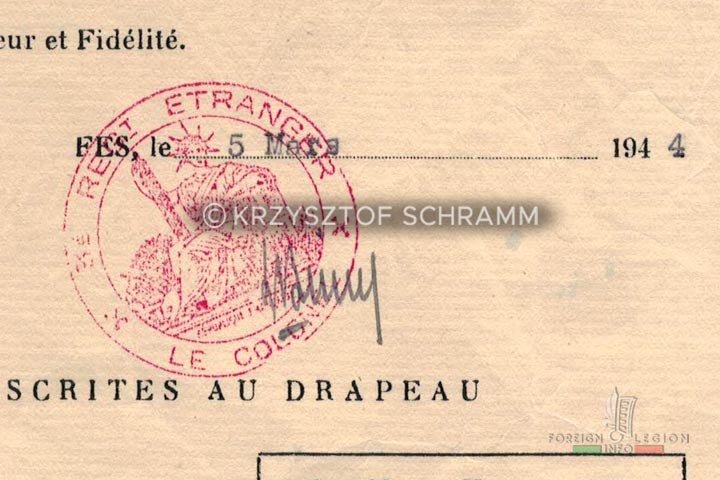
The April 22 memorandum also specified that the GCMP’s units would wear the insignia and double fourragère of the 3e REI. The colors and memorabilia of the disbanded regiments, held in the Foreign Legion barracks in Fez, would be entrusted to the group’s HQ Company. These included, in particular, the original colors of the RMLE from World War I and the former standard of the 1er REC.*
* After twenty years of service in Tunisia, the 1er REC had been transferred to Fez in late 1940. However, it had been obliged to leave the city in the second half of 1943 in preparation for its expected role in the liberation of France. Judging from the wording of the order, it can be assumed that even the 1er REC's administrative headquarters was to leave Fez permanently, unlike that of the 3e REI.
The Units and Their Locations
The GCMP’s units were spread across all of Morocco, and each one deserves its own introduction.
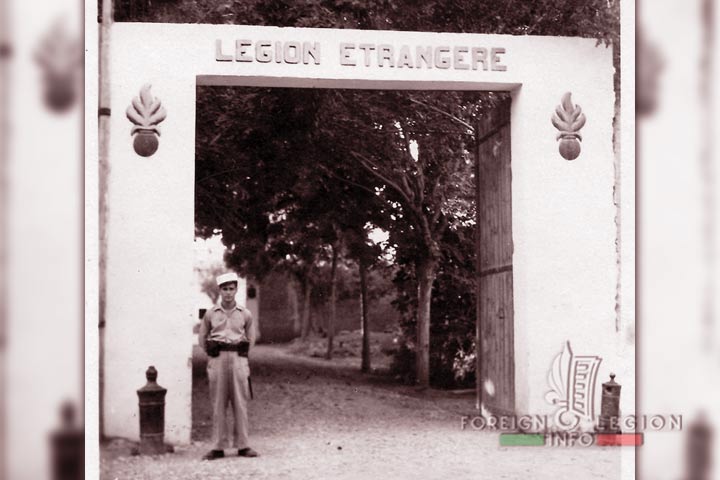
Lieutenant Colonel Brisset’s staff and the HQ Company, under Captain Cartier, remained at Camp Fontanel in Fez.
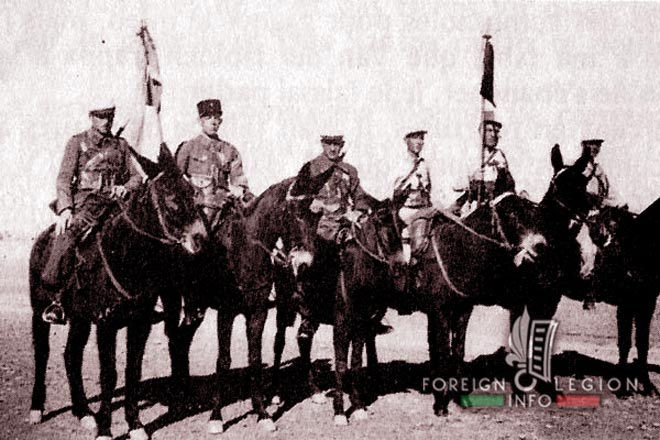
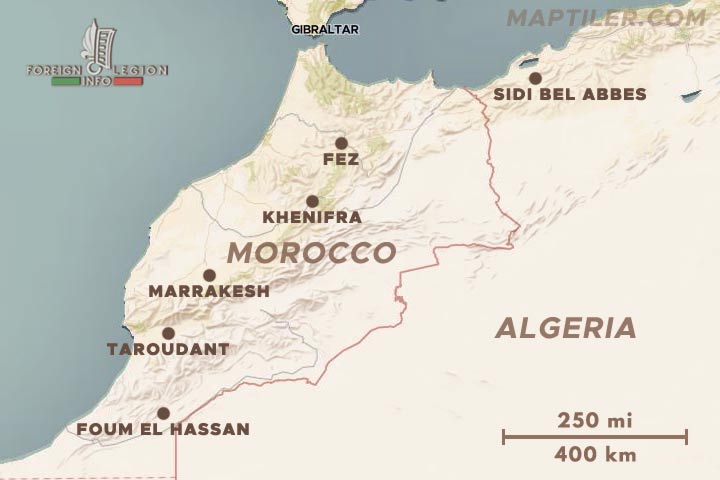
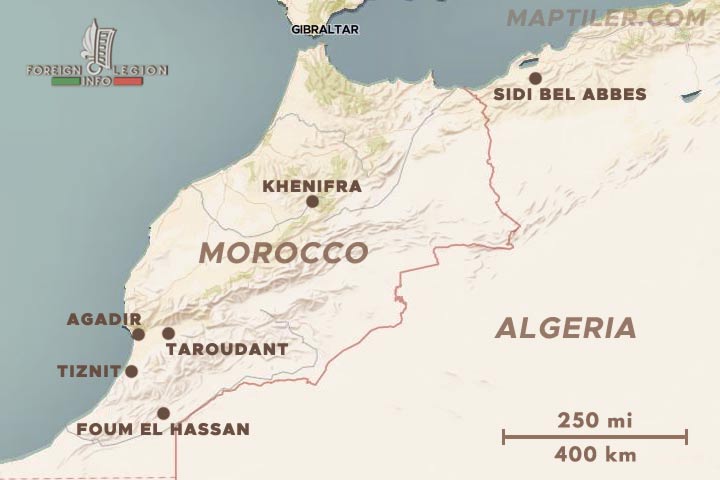
The 8th Mounted Company, commanded by Captain Pfirrmann (later commanding officer of the 5e REI in 1960–1961), was garrisoned at Khenifra, a town in the Middle Atlas in northern Morocco. The company had previously served as the Mounted Company of the 3e REI (1920–1940), and its history went back to 1907. It consisted of two mule pelotons (half-company formations), each made up of two platoons.
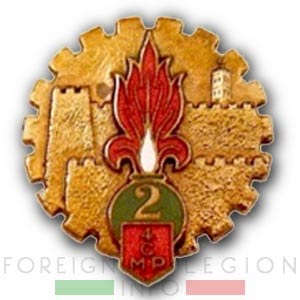
Alongside this last mounted company, the group included three motorized companies whose history is worth recalling. They had joined the 3e REI only at the end of March 1943, after the 2e REI was disbanded. Within the 2e REI, these three motorized units had formed the fourth companies of its three battalions. They had been created during the reorganization of the French Army at the end of 1940 and were known until the end of 1942 as Mixed Motorized Companies (CMP). They were the newest and most modern element of the Legion, and also the rarest. At the end of 1940, only two other motorized companies existed, both in Algeria, and one of them would be disbanded in 1943.
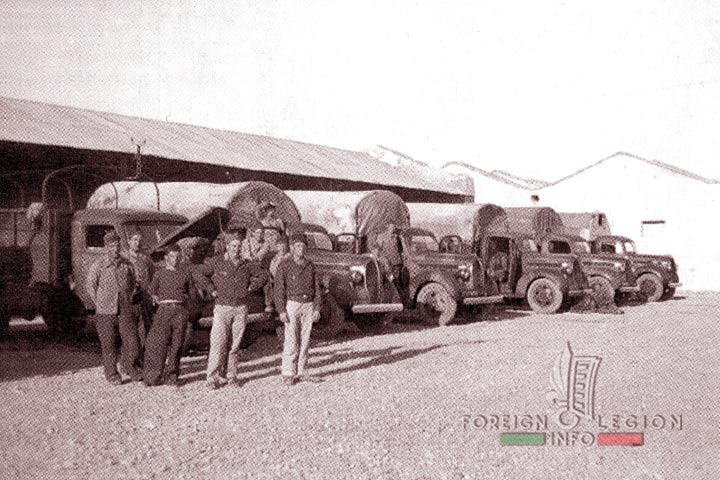
The CMPs partly replaced the mounted companies mentioned above. They also partly replaced the former heavy weapons companies, the support units equipped with machine guns and mortars within the battalions of the foreign infantry regiments. Each CMP consisted of an HQ platoon, two or three platoons of fusiliers-voltigeurs (riflemen) carried in Ford trucks, a machine-gun platoon, and a team of 75mm Jouhandeau-Deslandres mortars (75 J.D.). Each company had some thirty to forty vehicles of all kinds, including Latil or Laffly tank trucks and Panhard workshop trucks.
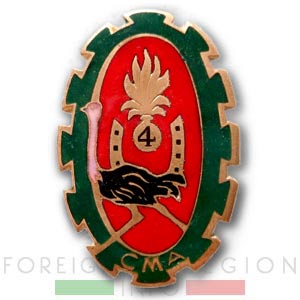
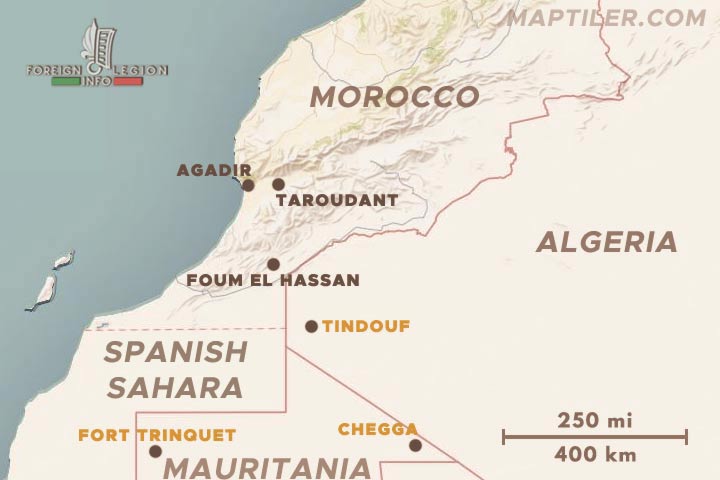
The 13th Motorized Company (13e CP), whose history went back to 1894 and the Aïn Sefra Mounted Company, had formerly been the 12th Mixed Motorized Company (12e CMP) of the 3rd Battalion, 2e REI. In June 1944, it was commanded by Captain Clémençon, who was replaced in July by Captain Laborde-Barbanègre. The company was garrisoned at the Le Moal Post at Foum El Hassan, in Morocco’s far south, where summer temperatures often exceeded 122°F (50°C). This was the southernmost Legion garrison in Morocco and probably, at the time, the southernmost Legion post anywhere in North Africa. It had been built in 1934 by this same company, which the year before had been converted from the Mounted Company 4e REI into that regiment’s Automobile Mounted Company (CMA/4). From 1933 to 1939, the company was commanded by Captain Gaultier. This iconic figure is regarded as the “father” of the postwar Legion because of his later service as commander of the DCRE (1945–1949).
Since the late 1930s, the 13e CP had been known within the Legion as the unit whose missions came closest to the romantic image that generations of young men had of the legionnaire crossing the vast desert of the Sahara. The company kept in regular contact with Tindouf, about 125 miles (200 km) away. This was the westernmost French base in Algeria and had been built in the desert with the help of the former CMA/4. The company also kept in touch with Fort Trinquet, some 375 miles (600 km) to the south in Mauritania, on the so-called Imperial Road connecting French North Africa with French West Africa (AOF). In addition, it regularly escorted senior officials of the French military administration on journeys to regions farther south, sometimes as far as French Sudan (present-day Mali).
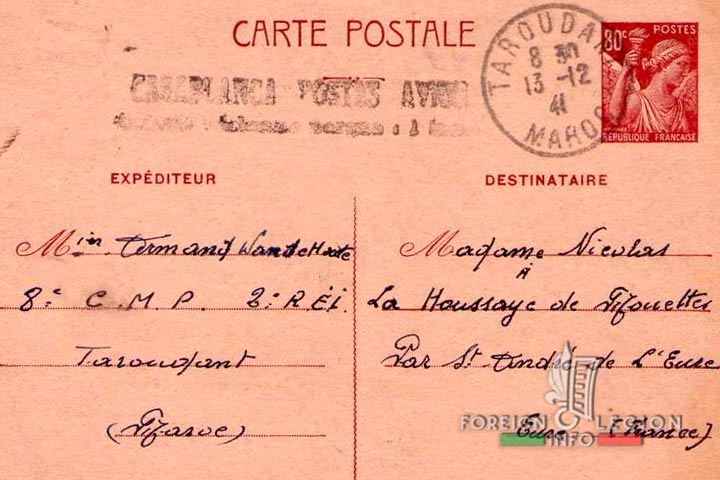
The 14th Motorized Company (14e CP), formerly the 8th Mixed Motorized Company (8e CMP) of the 2nd Battalion 2e REI, was stationed at the Captain Morel barracks in Taroudant, in southwestern Morocco. The town is known for its sixteenth-century ramparts, which run for nearly four miles (6 km) and include 130 towers and 19 bastions. The company was formed there probably in 1940, with Heavy Weapons Company elements of the 2nd Battalion 4e REI (CA2/4).
The 15th Motorized Company (15e CP) had been garrisoned since 1943 in Marrakesh, Morocco’s former capital and the former headquarters of the 4e REI. In November 1940, that regiment’s 9th Company had been reinforced with elements from a squadron of the disbanded 2e REC, and reorganized as the 4th Mixed Motorized Company (4e CMP) of the 1st Battalion 2e REI. It had been based at Ouarzazate in the southeast of the country. This unit later became the 15e CP.
Missions and Men
The GCMP’s units carried out a variety of missions. In addition to handling the group’s administration, the HQ Company supplied French units passing through Fez. In June 1944 alone, for example, it prepared and served more than 5,000 hot meals.
The four mounted and motorized companies were classified as “sovereignty” units (de souveraineté). Their main task was to maintain order and a French presence in their regions. They also took part in infrastructure work such as building roads and posts, supplied isolated garrisons, and escorted officials on their travels. In addition, they participated in regular military maneuvers and continued training to maintain their combat readiness.
Operationally, the 8th Mounted Company came under the Meknes Division, while the 15th Motorized Company reported to the Marrakesh Division. The two remaining motorized companies were assigned to the Agadir-Borderlands Subdivision (SAC). Established in 1934, the SAC was responsible for monitoring, stabilizing, and controlling the Sahara border areas, which were largely desert and particularly sensitive. Its area of responsibility covered not only southern Morocco but also the entire Tindouf region in Algeria, as well as the Fort Trinquet and Chegga areas in Mauritania.
On paper, each of the four mounted and motorized companies was supposed to have 230 to 250 men, nearly twice the strength of a regular infantry company. The demands of the war, however, had cut these numbers to barely workable levels. According to available information, each unit now had only 70 to 90 legionnaires. In all, the GCMP numbered no more than 400 men.
Some of these men were veteran legionnaires who had spent many years in the mounted companies. They preferred the solitude and nomadic life of the vast plains and semi-deserts of southern Morocco, far from modern civilization. Others were German, Austrian, or Italian nationals who had exercised their right not to fight their fellow countrymen, and they made up most of these units’ cadre. A final significant group consisted of men who, for various reasons, had not been selected for the combat units being formed for service in Italy and France.
Because of their roots, the men who filled their ranks, and their uninterrupted service in North African garrisons, these units would long be regarded, well beyond 1945, as the last guardians of the spirit, traditions, and strict discipline of the prewar “Old Legion.”
Uniforms and Equipment
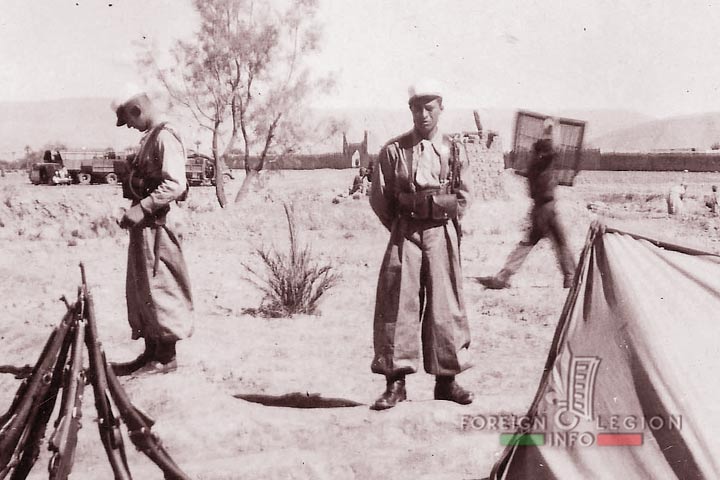
The legionnaires of the GCMP/3 kept their pre-1940 clothing in full, because the garrisons of southern Morocco were not included in the American rearmament program. That plan had benefited the RMLE and the 1er REC first, and their legionnaires were almost entirely outfitted with American uniforms and weapons.
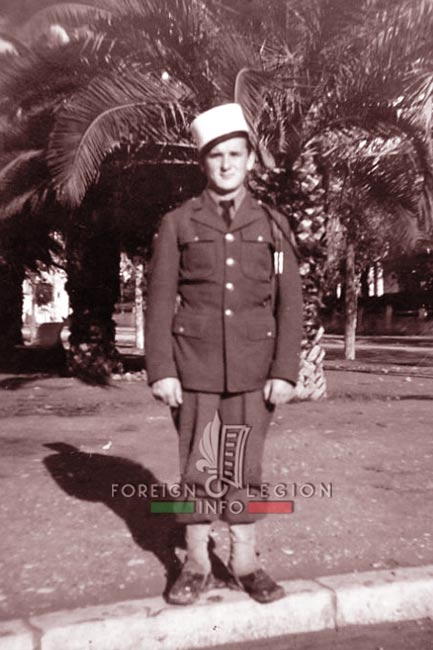
During 1944 and 1945, the Legion’s sovereignty units in North Africa therefore wore the French M1938 infantry uniform. They supplemented it with American or British items, depending on what the supply depots had to issue. Between 1943 and 1944, however, the way insignia and rank badges were worn changed significantly. Senior NCOs and officers, for example, moved their rank insignia from the lower sleeves to the shoulder straps. One notable and probably unpopular change was the complete abolition of long-service chevrons, which had been worn on the upper left sleeve. They would not return until around 1948, and then in a much more discreet form.
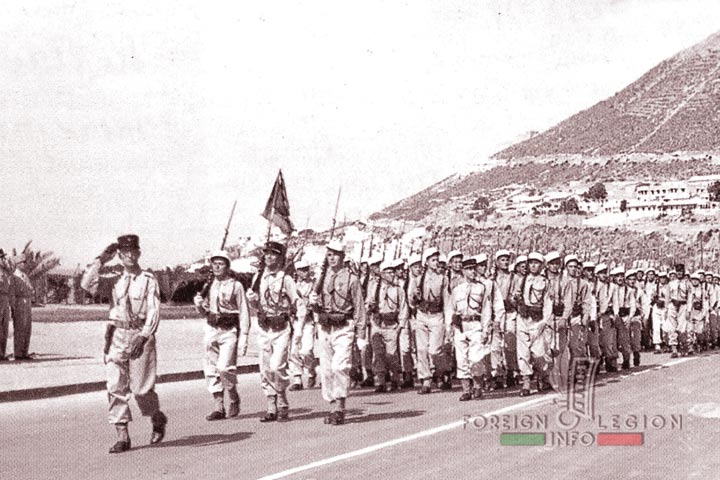
The white kepi, the green and red epaulets, and the blue sash characterized the legionnaire’s traditional parade dress. From 1945 onward, Legion units were routinely issued a green tie. The mounted and motorized companies in Morocco, however, kept the light khaki tie, which can still be seen in photographs from 1949.
The group’s equipment was also old. The maroon leather suspenders were the M1892/15 pattern as modified in 1934, carrying the 1888/16 cartridge pouches. The steel Adrian helmet (M1926/37 pattern) remained in use in these units until the mid-1950s.
The four companies’ weapons were old and fairly worn. They included five-round Berthier M1916 carbines, a few FM 24/29 light machine guns, and Hotchkiss M1914 machine guns.
As noted above, the vehicle fleet consisted mainly of Ford V8 trucks (“Manford”), Latil or Laffly tank trucks, and Panhard workshop trucks. Company commanders, for their part, most likely had Renault Viva Grand Sport cars, which would remain in service until 1946, or possibly even 1947. One source also mentions three Renault armored cars for each motorized company, but this cannot be reliably confirmed.
There was almost no radio equipment. A young officer of the 13e CP complained in his memoirs that the unit had no portable radio set that could be mounted on a vehicle or carried on a legionnaire’s back. Desert missions were therefore carried out without any communication with the company command post (PC) or with other military posts. The other GCMP units almost certainly faced the same situation.
Equipped and organized in this way, the GCMP’s units would see out the end of the war and the first postwar years.
The GCMP/3 in 1944
Let us now return to the chronology of events, beginning with the creation of the GCMP in June 1944.
After the group was created, a liquidation office remained in Fez until the end of August to settle the accounts of the disbanded 3e REI administrative headquarters.
On June 13, 50 legionnaires were sent to Sidi Bel Abbès, Algeria, as reinforcements for the combat units. Two weeks later, they were replaced by a detachment of 53 legionnaires from the DCRE.
During the summer, the staff and the HQ Company in Fez took part in ceremonies on July 27 marking the anniversary of Marshal Lyautey’s death. Marshal Lyautey, a prominent military commander and a man with great admiration for the legionnaires, was known as the “French empire builder” and the creator of modern Morocco, where he ruled from 1912 to 1925.
At the end of August, the GCMP legionnaires also joined in the celebrations of the liberation of Paris.
In September, Lieutenant Colonel Brisset inspected the 8th Mounted Company at Khenifra, the 15th Motorized Company in Marrakesh, and the 13th and 14th Motorized Companies at their bivouac south of Agadir, on the Sous River. The two companies had only just settled there after spending about two months on road construction near Djebel Lkest, a mountain in the Anti-Atlas, the range that runs across southern Morocco toward the edge of the Sahara.
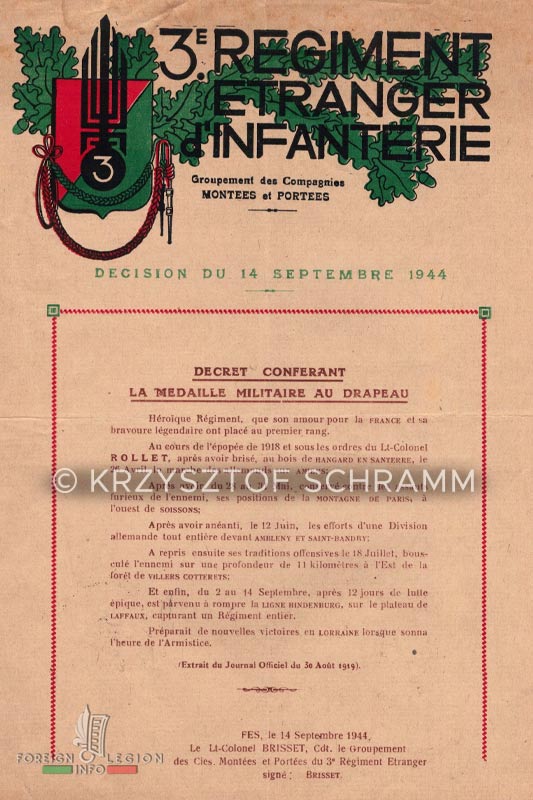
On September 14, the GCMP celebrated the 3e REI’s regimental day, commemorating the award of the Médaille militaire (Military Medal) to the colors of the 1914–1918 RMLE on September 14, 1919. A few years later, however, this anniversary would be transformed into Fourragère Day and rather dedicated to commemorating the breakthrough of the Hindenburg Line on September 14, 1918. It was this military action that had given the RMLE, and later its successor, the 3e REI, the right to wear the exceptionally rare double fourragère in the colors of the Légion d’honneur (Legion of Honor) and the Croix de Guerre (War Cross). Even today, in the late 2020s, only two French regiments wear this fourragère, the most prestigious one ever awarded.
On November 11, the group’s units took part in ceremonies marking the end of the First World War.
On December 24, for Christmas, the Legion’s band (La Musique, administratively attached to the DCRE at the time) came to Fez especially to play for the GCMP’s legionnaires at Camp Fontanel.
Meanwhile, in Europe, fierce fighting between the Allies and the Axis continued. The RMLE, carrying the colors of the 3e REI, fought alongside the 1er REC and the 13e DBLE in the hard battles for the liberation of France. Step by step, they advanced toward the east and northeast of the country and the German border.
The GCMP/3 in 1945
In January 1945, Captains Brulé and Cheliakine were assigned to the GCMP staff. Captain Brulé would later be the last commanding officer of the 4e REI, in 1963–1964. Between 1941 and 1943, he had served with the 4th Foreign Legion Demi-Brigade (4e DBLE) in Senegal, in French West Africa.
That same month, the GCMP’s HQ Company, still under Captain Cartier and his deputy, Lieutenant Legros, served more than 4,000 hot meals to soldiers passing through Fez.
From January 17 to February 4, the Legion’s band from Sidi Bel Abbès was again in Fez with the GCMP. It performed at various military ceremonies and gala evenings, where it was very well received.
At the same time, the RMLE and the 1er REC were still fighting the last bitter battles in Alsace. This region was fully liberated at the end of March. The two units then moved into Germany, where they helped liberate one region after another. At the end of April, Legion units entered Austria, and the war in Europe was quickly drawing to a close.
During this period, Lieutenant Colonel Brisset was promoted to colonel.
On April 30, the GCMP commemorated the 1863 Battle of Camerone, the Legion’s traditional annual celebration.
On May 3, the capture of Berlin was celebrated with enthusiasm, and the GCMP’s legionnaires were given time off. The Legion’s band, back in Fez, played at a celebration held for the former legionnaires (Anciens) living in the city.
On May 8, the war in Europe ended. The next day in Morocco, memorial ceremonies for those who had died in action were followed by time off.
On July 1, the RMLE became the new 3e REI, after marching under the Arc de Triomphe in Paris at the end of June. On the same date, another Foreign Legion Marching Regiment was officially formed at Sidi Bel Abbès for the war against the Japanese in the Pacific.
By July 1945, the Foreign Legion therefore consisted of the DCRE, the GCMP, the 3e REI, the 1er REC, the 13e DBLE, a Saharan Motorized Company (CSPL), a Disciplinary Company, and the RMLE — soon to be designated the RMLE-EO (Far East RMLE). In China, survivors of the former 5e REI formed a Marching Battalion.
In August, an advance detachment of the new 3e REI arrived in Fez. The regiment itself followed in early September and moved into Camp Stéfani.
On September 1, at Camp Stéfani, Colonel Brisset handed over the colors of the 1914–1918 RMLE to Colonel Olié, commanding officer of the new 3e REI. The GCMP’s HQ Company had guarded these colors since the end of 1942, when it was still the Depot Company of the 3e REI’s administrative headquarters.
A few days earlier, the standard and memorabilia of the 1er REC, which the GCMP had also kept in Fez, had been returned to that regiment, which had just come back to Morocco.
On September 14, the GCMP and the 3e REI celebrated the regimental day together. In Fez, the ceremonies were presided over by Colonel Lambert of the DCRE, and Colonel Miquel of the 1er REC also attended.
In October, Captain Brulé, previously on the GCMP staff, took command of the HQ Company.
Even the group’s command did not escape change. On October 18, Colonel Brisset was replaced by Lieutenant Colonel Georges Guyot. The latter had been one of the founding officers of the 4e REI in November 1920 and later, in the 1930s, commander of its Machine Gun Company 2nd Battalion (CM2/4; coincidentally, after several changes of name, that same company later became the GCMP’s 14th Motorized Company).
On November 1, Captain Brulé was transferred to the 3e REI. He was replaced as commander of the HQ Company by Lieutenant Pohl. Until then, Pohl had been the GCMP’s administrative and accounts officer (officier des détails) and the color-bearer for the old RMLE colors, which served as the group’s emblem.
In the 13e CP, Lieutenant Lacote (later commanding officer of the 13e DBLE in Djibouti, 1962–1965) succeeded Captain Laborde-Barbanègre.
By this time, the GCMP’s motorized companies consisted of only three platoons of fusiliers-voltigeurs (riflemen). The machine-gun platoon that had previously been part of each company no longer existed.
The GCMP/3 in 1946
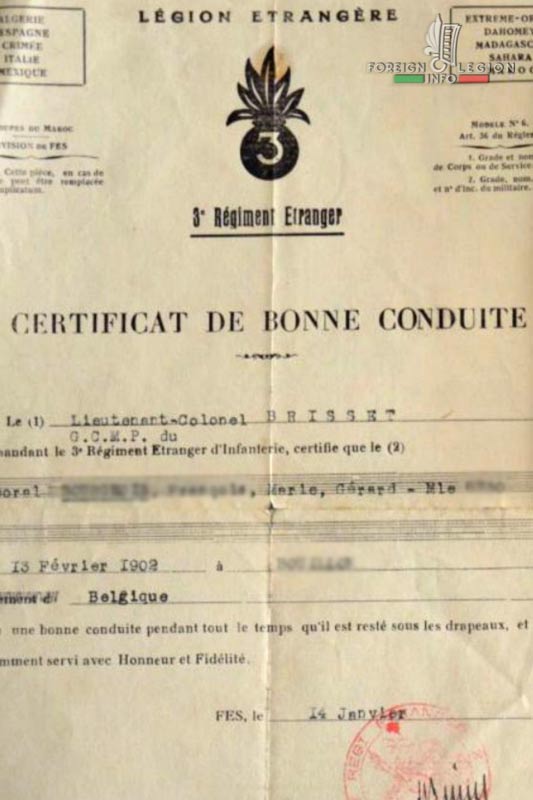
In early January 1946, the 3e REI, which had been selected for service in Indochina, left Fez for France. It moved into the camps at Aubagne and Carpiagne, near Marseille, where its men underwent three months of training. Coincidentally, these are the same sites where the 1st Foreign Regiment (1er RE) and the 1er REC are stationed today. The regiment’s absent and unfit personnel were transferred to the GCMP.
On February 16, the 15e CP left Marrakesh and moved to Tiznit, in southern Morocco. From then on, all three motorized companies were in the same region and attached to the Agadir SAC.
Meanwhile, the manpower situation, which until then had remained severely depleted, began to improve. The 13e CP, for example, had numbered no more than 80 men at the end of 1945, but it had already grown to 200 by late February 1946. The group’s other units, and the rest of the Legion as a whole, saw similar increases. Most of the new recruits were German volunteers, many of whom had been recruited in prisoner-of-war camps.
In April, a new 4e REI, still in the process of forming, moved into Fez to replace the 3e REI, which had left for the Far East. At the same time, the GCMP headquarters prepared to move to southern Morocco.
At the end of April, the group celebrated the anniversary of the Battle of Camerone.
On May 21, the GCMP/3 headquarters handed over to the 4e REI the duties it had performed in Fez and left its camp, which the 3e REI had occupied since 1920. It moved some 375 miles (600 km) south to join its three motorized companies. On May 23, it settled in Agadir at Camp IV, later known as Camp Sigmann.
During the first half of the year, Major Panchuquet, a former commander of the 3e REI’s Mounted Company (the future 8e CM), succeeded now-Major Maussenet as second-in-command to the GCMP’s commanding officer. Between July and September, Panchuquet temporarily commanded the group while Lieutenant Colonel Guyot was away in France.
In June, Lieutenant Lacote was succeeded in the 13e CP by Captain Chargois, a non-Legion officer, who would lead the company only until the end of September. Lacote, for his part, took command of the 14e CP.
On July 14, Bastille Day, these two motorized companies took part in the military parade in Agadir.
In the summer, the 13e CP legionnaires restored Camp Alibert in Agadir for the group’s use.
Also that year, the units’ vehicle fleet was renewed. Worn-out vehicles were replaced with vehicles left over from the Allied campaigns in North Africa. These were mainly British trucks “with a forward cab,” probably Bedford QLs, as well as lighter vehicles: American Dodge 4x4s and, most likely, British Bedford MWs. The lighter vehicles were used mainly by officers and NCOs, and some of the Dodges, fitted with radio sets, also served as radio liaison vehicles.
But nothing lasts forever. The 3e REI existed once again, so there was no longer any need to preserve its legal existence by other means. Moreover, the regiment was now serving in Indochina, and keeping a small part of its personnel in Morocco was certainly a logistical and administrative problem. This was probably what led to the decision to make the former group independent and to combine its motorized units, without the mounted company, into a single motorized formation.
Accordingly, under a ministerial order of September 5, the GCMP of the 3e REI became a fully independent unit as of October 1, 1946. Its new title was the Foreign Legion Moroccan Motorized Company Group (GCPLEM, also designated GCPLE or GCPLM).
Under the same order, the 8th Mounted Company left the group. As of October 1, it was attached to the former 4e REI in Fez, which had been converted into the 4th Demi-Brigade (4e DBLE) after only a few months of existence.
With this reorganization, the last guardian of the 3e REI’s traditions in Morocco lost its unique privilege to wear the regiment’s insignia, which were removed from the uniforms of the group’s legionnaires. So ended the story of a remarkable unit, one that had brought together and preserved elements of every Foreign Legion regiment stationed in Morocco between the wars (the 2e REI, 3e REI, 4e REI, and 2e REC).
From then on, its legacy continued in the GCPLEM: the Moroccan Motorized Company Group.
———

———
Main information sources:
War Diary of the GCMP/3 (1944-1946)
Képi blanc magazine
Vert et Rouge magazine
Michel Brun: A Foum El Hassan avec la 13e CPLE 1946-1947 (Képi blanc, 1996-1997)
J. Brunon, G.-R. Manue, P. Carles: Le Livre d’Or de la Légion (Charles-Lavauzelle, 1976)
Tibor Szecsko : Le grand livre des insignes de la Légion étrangère (S.I.H.L.E., 1991)
———
Learn more about the Foreign Legion’s history:
Foreign Legion in the Balkans: 1915-1919
97th Division Reconnaissance Group
Parachute Company 3e REI
Autonomous Battalion of the 5e REI (BFC 5), 1945-1946
Foreign Legion Repair Platoons in Africa
GOLE: Foreign Legion Operational Group
———
The page was updated on: October 8, 2026