
The 61st Engineer Legion Mixed Battalion (61e BMGL) was a combined French Army unit composed of regular Army sappers and legionnaires. Activated in early 1971, it was tasked with building Camp Canjuers, the largest live-fire training range in Western Europe at the time. After later working at the camps of Larzac, La Courtine, Caylus, and des Garrigues, the 61e BMGL was deactivated in 1982.
—
L'article en français : 61ème Bataillon Mixte de Génie Légion
—

Creation of the 61e BMGL
In 1962, after the Algerian War ended and as French forces prepared to redeploy from North Africa to Europe, a decision was taken to build a new large training area in France, intended primarily for armored cavalry. To carry out this project, Foreign Legion engineer elements were selected and deployed in early 1968 to Canjuers, in the Var Department of southeastern France, north of Draguignan. They were later reinforced by regular army engineers, and the two groups worked side by side there until late 1970. Those elements would then merge into a single unit.
Accordingly, the 61st Engineer Legion Mixed Battalion (61e Bataillon Mixte de Génie Légion, 61e BMGL) was activated at Camp Canjuers on January 1, 1971. A combined Engineer Corps/Foreign Legion unit, it remains the only such unit established in metropolitan France to date, and the second unit of this type then in existence, after the 5th Mixed Regiment serving in the Pacific.
The 61e BMGL inherited the traditions of the 61st Engineer Battalion (1939–1940) in France and the 61st Engineer-Legion Battalion (1949–1955) from the Indochina campaign. Under its fanion, decorated with the 1939–45 War Cross and the Overseas Operations War Cross (including a palm for a citation in orders), the battalion brought together the engineer elements that had been working at Canjuers for the previous three years.
Assigned to the 7th Military Region, the 61e BMGL consisted of the Command and Services Company (CCS), the Engineer Corps Construction Company (CTG), and the Legion Construction Company (CTL). The latter was, in fact, the former Foreign Legion Pioneer Company (CPLE), which had been stationed at Canjuers since February 1968.
At the beginning, the strength of the battalion was 511 men: 24 officers, 91 non-commissioned officers, and 396 enlisted personnel (sappers, conscripts, and legionnaires). Lieutenant Colonel Debent, a former lieutenant with the 2e BEP in Indochina, assumed overall command.
The Legion Construction Company numbered 151 men, including 6 officers, 23 non-commissioned officers, and 122 legionnaires. It was organized into a command platoon and three construction platoons. The company remained under Captain Doussau, who had commanded it since its formation in 1968.


Canjuers 1971-1974
The mission of the 61e BMGL was to continue developing the future Canjuers firing range: a vast maneuver area of 86,500 acres (35,000 hectares) and 22 miles (35 kilometers) in length, destined to become the largest military training camp in France – and one of the largest in Western Europe.
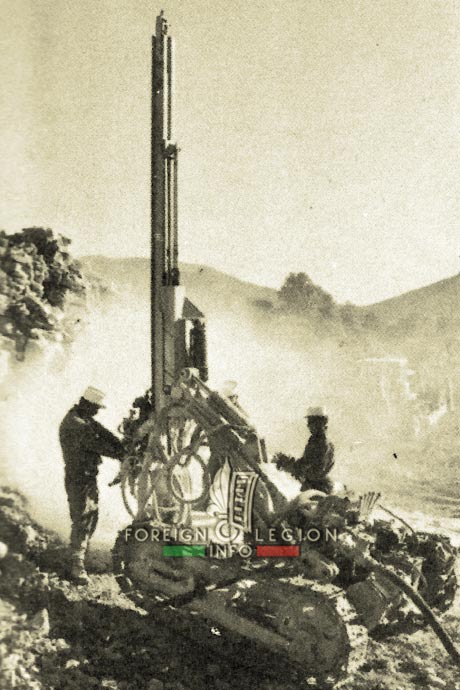
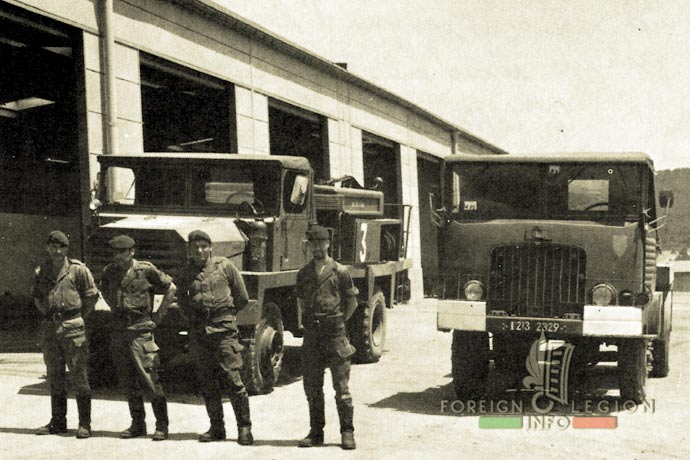
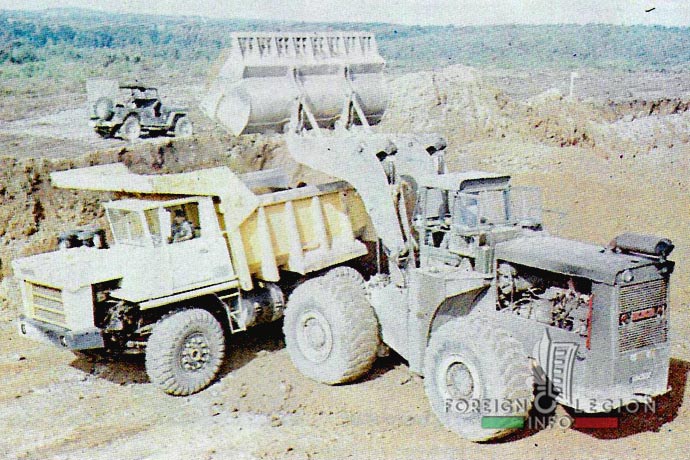
To accomplish this mission, the battalion maintained a substantial fleet of heavy equipment and vehicles. Its heavy machinery included bulldozers, graders, agricultural tractors, self-propelled equipment, concrete mixers, rock-drilling rigs, crushers, and cranes, among others. The vehicle fleet included liaison vehicles (cars), tractor units, dump trucks, recovery vehicles, and tanker trucks.
The 61e BMGL first had to complete the overall development of the camp’s built-up area, enabling civilian contractors to proceed with the construction of new, modern barracks. The battalion’s units then built infrastructure across the maneuver area as a whole: the Auveine, Lagne, Amandiers, and Chaudoin firing ranges; the network of armored-vehicle tracks; the access tracks to the mobile targets; and the South and West beltways.
In addition, the battalion completed a VTC road (for vehicles transporting a nuclear load), as well as bypasses and the widening of Departmental Road 955 (RD955), which provided access to the camp.
To support these construction sites – especially the roads and tracks – legionnaires and sappers extracted hundreds of thousands of tons of construction aggregate from the Petorgues and Comboutaire quarries.
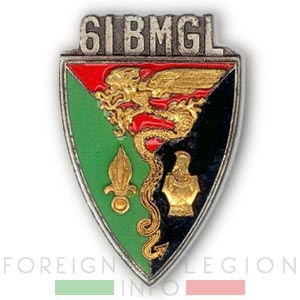
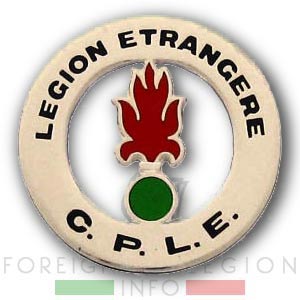
In April 1971, the 61e BMGL’s unit badge was issued. The men of the Legion Company also retained their former badge, that of the CPLE, and wore it alongside the new battalion insignia. The practice was soon adopted by the battalion’s commanders as well – a highly unusual arrangement.
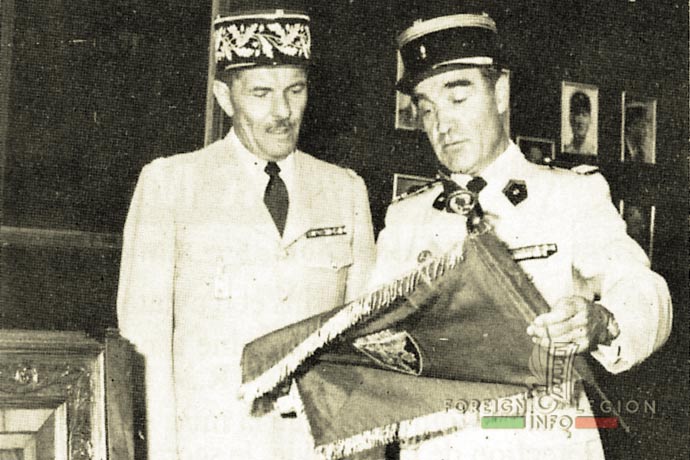
The battalion’s fanion (banner) arrived shortly afterward, in May.
In August 1971, Captain Doussau left the CTL after commanding it for three and a half years. He was succeeded by Captain Cattaneo, who had begun his career as a simple legionnaire in 1946.
In October 1972, the 61e BMGL also changed commanders: Major Bouchier succeeded Lieutenant Colonel Debent.
In May 1973, Captain Cattaneo took his well-deserved retirement after 27 years in the Legion. He was replaced by Captain Gansmann, who became the new commander of the CTL.
From the second half of 1973 onward, new construction sites were added to the battalion’s agenda, including road works for the commune of Montferrat, located south of the camp.
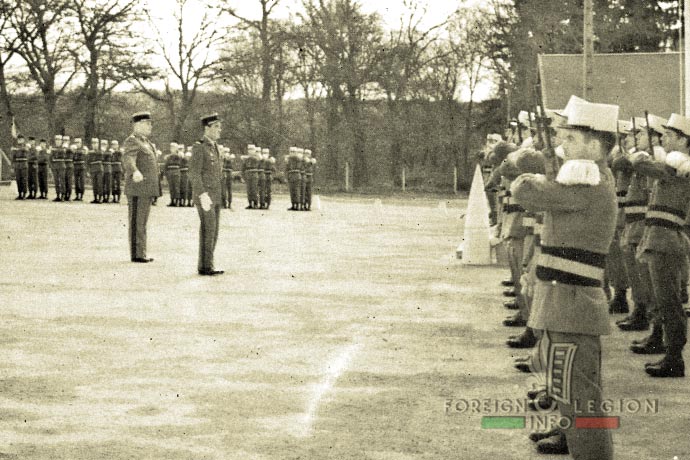
On October 11, 1974, Major Brunet replaced then-Lieutenant Colonel Bouchier at the head of the battalion. During the ceremony, a 19-mile (30 km) road, part of the camp’s future beltway, was officially opened.
By that time, the camp’s new, modern barracks had already been completed, along with other facilities (e.g., a swimming pool, post office, cinema, and restaurant). This allowed army units to come to Canjuers to conduct their first training exercises.


Canjuers 1975-1978
The years 1975 and 1976 saw additional projects completed, including the construction of a helicopter landing zone, an obstacle course, a launch site for MILAN anti-tank missiles, and facilities for artillery observation posts. The two construction companies also built several firebreaks with access roads as fire-prevention measures. From January 1975 onward, a fire-fighting platoon composed exclusively of legionnaires (five groups) permanently monitored the entire camp.
In May 1975, Captain Gansmann was replaced by Captain Stemberger as commander of the Legion Company. Stemberger, a former legionnaire who had enlisted in 1949, left the company and the Legion in October 1976. Captain Pierquin succeeded him.
That same month, in October 1976, Lieutenant Colonel Bissonnier took command of the 61e BMGL.
In 1977, the CTL legionnaires completed further projects, including the Guent submersible ford (Lieutenant Phong’s platoon), the Lagnes tank firing range, consisting of 8 miles (13 km) of tracks (Lieutenant Mey’s platoon), and the Amandiers firing range (Lieutenant Truc’s platoon). The 2nd Platoon (Lieutenant Bustos), equipped with a crusher and giant Berliet T30 trucks, extracted, crushed, and delivered thousands of tons of construction aggregate for these sites.
Nevertheless, 1978 marked the end of the 61e BMGL’s mission at Canjuers. In seven years of hard work, the battalion achieved impressive results:
- 600,000 m3 of earthworks
- 800,000 m3 of material transported
- 400,000 m3 of construction aggregate extracted
- 70 miles (110 km) of roads
- 250 miles (110 km) of tracks
- 50 fords and concrete piers for tanks
- 4 outdoor campsites (each for a regiment, i.e., about 1,000 men)
- a helicopter landing zone
In August 1978, the battalion began its departure from Camp Canjuers. It was replaced by the Foreign Legion Reinforced Road Building Company (CRTRLE), created that same month.
Simultaneously, on August 25, Captain Llorens took command of the CTL.



Larzac 1978-1981
In September 1978, the 61e BMGL was stationed at Camp Larzac (also known as Camp La Cavalerie), near Millau in the Aveyron Department of southern France. It was an older military camp with a nearby training area, both slated for renovation and modernization.
The necessary preparations were made to install the battalion in the camp, a process that continued through December.
On October 17, Lieutenant Colonel Bastian became the new commander of the 61e BMGL.
In 1979 and 1980, work at Larzac was in full swing. The most important task was the development of the ALAT Zone. This was a major 40-acre (16-hectare) construction site for a French Army Light Aviation regiment of combat helicopters – about 60 aircraft. At the same time, the battalion also had to build a road network for the camp, along with parking areas for tanks and other vehicles.
On August 25, 1980, Captain Bustos succeeded Captain Llorens as commander of the Legion Company.
A month later, the legionnaires of the 2e REP presented the new FAMAS rifle to the personnel of the CTL, which was still equipped with the older MAS 49/56.
In October, Lieutenant Colonel Bironneau took over the 61e BMGL. He was a veteran of the battalion, having served as a captain during its earliest period in 1971.
In 1981, the CTL legionnaires continued work on the ALAT Zone. Their other projects included five campsites (bivouacs with the capacity of one regiment per bivouac) and development of the site for the future military railroad station at L’Hospitalet.
However, for political reasons, work at Larzac had to be interrupted prematurely. The battalion’s units were instead detached to other locations.


La Courtine and Garrigues 1981-1982
In early July 1981, the battalion dispersed and its units became semi-independent. The Legion Construction Company was ordered to Camp La Courtine in central France, while the Engineer Corps Construction Company moved first to Camp Caylus and then to Camp Souge, near Bordeaux in western France. Within a few months, the 61e BMGL succeeded in launching eleven new construction sites spread across a 300-mile (500 km) front, from the Atlantic coast to the Mediterranean. Only the CCS remained at the rear base at Larzac.
At Camp La Courtine, the legionnaires were tasked in particular with building a moving target for the MILAN anti-tank missile range. Using D9 and D6 bulldozers, loaders, T30 trucks, and compactors, they shifted more than 40,000 cubic meters of material extracted from ground littered with shells, balls, cartridges, and other projectiles accumulated over decades of live-fire training. This debris required special handling and the presence of a bomb disposal team.
In October, the Legion Company had to move again, this time to Camp des Garrigues near Nîmes in southern France. There, from mid-November 1981 to late March 1982, the CTL carried out major work to upgrade the camp’s infrastructure, including construction of a shooting range requiring 15,000 m3 of earthworks; the building of a 4-mile (7 km) armored-vehicle track; improvement of a large firebreak; and clearance of more than 50 acres (20 hectares) of scrubland.
Back at Camp La Courtine in April 1982, the legionnaires continued their tasks: a moving target for the MILAN missile range, a simulated urban training area, a 22-mile (35 km) beltway along the north of the camp, and various trench works.
By this point, however, the end of the battalion was approaching. On July 12 at Larzac, the last joint ceremony took place, marking the battalion’s official departure from the camp.
The unit then split into two parts, permanently separated. The CCS and CTG companies moved to Camp Coëtquidan before joining Camp Mourmelon in northeastern France, where they formed the 72nd Engineer Regiment on November 1. The CTL legionnaires, commanded by Captain Kampmeyer since late June, remained at Camp La Courtine until late October.
On November 2, 1982, a small dissolution ceremony took place at Quartier Viénot in Aubagne. The Legion Construction Company was formally disbanded, and the unit’s fanion was deposited at the Legion Museum. The history of the battalion that built the largest military camp in western Europe came to an end.
Today, the camps of Canjuers, Larzac, des Garrigues, and La Courtine still preserve tangible traces of the Foreign Legion’s effectiveness. The men of the 61e BMGL reaffirmed that legionnaires can be both elite soldiers and capable builders – much like their predecessors in the Roman Empire and their forebears in the North African and Indochina campaigns.






———
Main information & images sources:
Képi blanc magazines
Pierre Dufour: Génie-Légion (Lavauzelle, 2000)
Wikipedia.org
———

———
Related articles:
6th Foreign Engineer Regiment
3e BMLE: 3rd Foreign Legion Task Force
16th Engineer Maintenance Company
2nd Foreign Engineer Regiment: The origins
BLEM: Foreign Legion Madagascar Battalion
—
The page was updated on: January 10, 2026