
The 1st Foreign Parachute Regiment (1er REP) was an airborne unit of the French Foreign Legion, created in Algeria in late 1955. Based in Zeralda, the regiment took part in the Algerian War and was seen as one of the most elite units of the French Army at the time. However, the prestigious 1er REP was prematurely disbanded following its active participation in the Generals’ Putsch of Algiers, in 1961.

1er REP: 1st Foreign Parachute Regiment in 1955
After its return from French Indochina in Southeast Asia to Algeria in French North Africa, the 1st Foreign Parachute Battalion (1er BEP), a unit annihilated twice during the war in Indochina, was ordered to be transformed into a regiment.
Thus, the 1st Foreign Parachute Regiment (1er Regiment Etranger de Parachutistes, 1er REP) was established in Algeria on September 1, 1955 *, with the rear base located in Zeralda, a town located not far from the capital of Algiers. The 1er REP inherited the battalion’s number, history, and traditions, as well as the yellow-green fourragère (shoulder cord), a decoration received thanks to the five unit citations (mentions in dispatches) the battalion earned during the war in Indochina.
Major Pierre Jeanpierre retained command. His unit consisted of 36 officers, 112 NCOs, and 666 legionnaires (814 men in total).
* The date of August 1 was used in official Legion sources until the 1960s
1er REP’s composition in Algeria in September 1955
- Commander : Major Jeanpierre
- HQ Company : Captain Faulques
- 1st Company : Captain Abraham
- 2nd Company : Captain Giese
- 3rd Company : Captain de Saint Marc
- 4th Company : Captain Le Bras
- Combat Support Company (CA) : Lieutenant Dupoux
The regiment took on the tasks of the 1er BEP and continued patrols and anti-insurgent operations in the Tebessa sector in northeastern Algeria, along the border with Tunisia. The actions were aimed at the rebels, represented mainly by the National Liberation Front (FLN) and its armed branch, the ALN.
From September to December, the regiment saw operations near Tebessa, Negrine, Ferkane, and Bir El Ater, still in the same sector. From the end of September to early October, its men were involved in Operation Timgad, a major joint operation at the border with Tunisia, not far from the Djebel El Djorf mountain. The Legion’s 21e CPLE, 22e CPLE, 23e CPLE, 1re CSPL, 2e CSPL, and 2e REI also participated. An important gathering of rebel leaders from the Aures and the Nementchas mountains was destroyed.
In October, Captain Germain died in an accident. A former commander of the 1er BEP in Indochina in 1954, he served as the second-in-command of the 1er REP.
In December 1955, the Reconnaissance Squadron (ER) was created within the regiment, under Captain Abraham who had left the 1st Company. The squadron was equipped with Dodges and Jeeps (including those with the 105 mm M40 recoilless rifle). The squadron was stationed in Soumaa near Blida, about 10 miles (16 km) south of Zeralda.
In 1955, both the 1er BEP and the 1er REP killed dozens of rebels.
1er REP: 1st Foreign Parachute Regiment in 1956
In early January, the regiment conducted operations in the Ferkane region, south of Tebessa.
In February, Lieutenant Colonel Albert Brothier took command. Earlier, from 1952 to 1953, Brothier had led the 1er BEP in Indochina. Major Jeanpierre became a deputy commander.
1er REP’s composition in Algeria in February 1956
- Command : Lieutenant Colonel Brothier
- HQ Company : Captain Faulques
- 1st Company : Captain Martin
- 2nd Company : Captain Giese
- 3rd Company : Captain de Saint Marc
- 4th Company : Captain Glasser
- Combat Support Company (CA) : Lieutenant Dupoux
- Reconnaissance Squadron (ER) : Captain Abraham
In early April, following Morocco’s independence from France, the 1st and 2nd Companies deployed to Marnia in northwestern Algeria, at the Moroccan border.
At the same time, the Reconnaissance Squadron deployed some 130 miles (200 km) west of Algiers, to the Orleansville region.
In late April, the whole regiment took part in helicopter Operation 256 in the Ouarsenis mountain range, west of the capital. It remained in that region until May.
In May, the companies operated in the Oran region in northwestern Algeria, as well as in the capital city of Algiers and its surroundings. On May 26 and 27, the legionnaires participated in anti-insurgent Operation Casbah in the capital, alongside about 5,000 French troops. During searches of houses and apartments, some 400 suspects were arrested.
On June 4, the 1er REP received the new regimental colors from Colonel Lennuyeux, then-chief of the Foreign Legion.
A few days later, on June 8, the regiment’s HQ Squadron and 1st and 3rd Companies deployed to Tindouf, a Saharan commune close to the Mauritanian, Spanish Saharan and Moroccan borders. Since late June, only the ER Squadron had operated there against local rebel groups. The ER men were crossing disputed borders and carrying out desert raids in the sector, alongside their comrades from the 4e CSPL.
Meanwhile, the regiment (less the ER) operated near the capital.
On July 1, the 1er REP was assigned to the newly constituted 10th Parachute Division (10e DP) under General Massu.
In early August, the regiment – including the returned Squadron – was tasked with a new mission: to prepare for an Anglo-French invasion of Egypt. There, Egyptian leader Nasser had taken control of the strategically important Suez Canal, in violation of agreements he had signed with the British and French governments which administered the canal. Besides, France saw Egypt as a national threat, because Nasser continuously supported FLN rebels in Algeria.
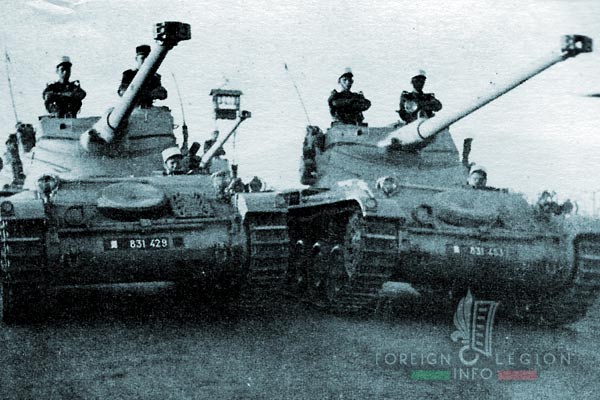
The new mission was originally code-named Operation Hamilcar (Amilcar in France) and later renamed as Operation Musketeer (Mousquetaire in France). The 1er REP was chosen as one of the main landing forces of the operation. Because of that, it was reinforced by a tank squadron from the 2e REC, equipped with 17 AMX-13 French light tanks. On the beaches near Algiers, both units began intensive landing exercises that continued through October. In the meantime, the 1er REP units were taking part in military operations in and around the capital.
On November 1, the 1er REP and the 2e REC squadron left Algeria for Cyprus, where French Army and Navy elements reinforced the detachment. They left Cyprus for Egypt a few days later.
On November 6, Operation Musketeer started. Anglo-French landings were aimed at Suez cities Port Said and Port Fouad. The latter was to be seized by the 1er REP detachment led by Lt. Col. Brothier. The operation was a great success; the Egyptian troops quickly retreated.
However, the United States immediately imposed sanctions on the British financial system to break the British effort and stop the invasion. Although very successful, the Anglo-French troops were forced to cancel the operation on its third day and withdraw. By late December, all the Anglo-French troops had left Egypt, including the 1er REP and 2e REC men. Profoundly disappointed, they returned to Algeria on December 29.




1er REP: 1st Foreign Parachute Regiment in 1957
Following the cancellation of Operation Musketeer, the 2e REC squadron didn’t return to its original unit. Instead, it merged with the 1er REP. Thus, on January 1, it became the Tank Squadron (Escadron de Chars, EC), consisting of three platoons and a LVT landing vehicle detachment. Commanded by Captain Maurice Hautechaud, with Lieutenant Chevallereau as his deputy, it was the only purely airborne cavalry unit of the Legion. The men continued to wear silver rank insignias (instead of the gold ones meant for infantry) and use cavalry ranks. Nevertheless, after the Suez campaign, their tanks became useless and were gradually replaced by Jeeps.
In mid-January, the Battle of Algiers started. The entire 1er REP was in the capital to restore order in response to the heightened activity of the FLN rebels and the growing number of terrorist attacks they were launching in the city. Housed in ordinary apartments or villas, the para-legionnaires conducted daily patrols to maintain order and night raids to find rebel suspects and their hideouts (full of explosives and firearms). In the meantime, both squadrons (ER and EC) carried out street patrols and roadside checks. The operations in the capital continued until mid-April.
In the meantime, on March 25, freshly promoted Lt. Colonel Jeanpierre succeeded Lt. Colonel Brothier as the commanding officer of the regiment.
1er REP’s composition in Algeria in March 1957
- Command : Lieutenant Colonel Jeanpierre
- HQ Company : Captain Faulques
- 1st Company : Captain Martin
- 2nd Company : Captain Estoup
- 3rd Company : Captain Allaire
- 4th Company : Captain Gamas
- Combat Support Company (CA) : Captain Glasser
- Reconnaissance Squadron (ER) : Captain Abraham
- Tank Squadron (EC) : Captain Hautechaud
In April, the ER squadron returned to Tindouf. Saharan operations in Mauritania and Spanish Sahara (now Western Sahara) resumed, alongside two motorized companies of the 4e REI. The squadron didn’t come back until mid-June.
In late April, a week-long operation took place in the Medea region, southwest of Algiers; 29 rebels were killed.
On May 5, the six-week Operation NK3 started in the Kabylie, a mountainous coastal region east of the capital. During the operation, 175 rebels were killed by the 1er REP, while another 102 rebels were taken prisoner. On May 17, the 1st Company under Captain Martin killed over 80 rebels in the Battle of Djebel Bou Zegza, which was part of the operation.
In June, the 4th Company and CA again maintained order in Algiers.
On July 14, the colonel, the color guard, and an honor company of the regiment participated in the Bastille Day Military Parade in Paris.
In late July, the month-long Operation NC15 started in the Medea region, south of the capital; 92 rebels were killed.
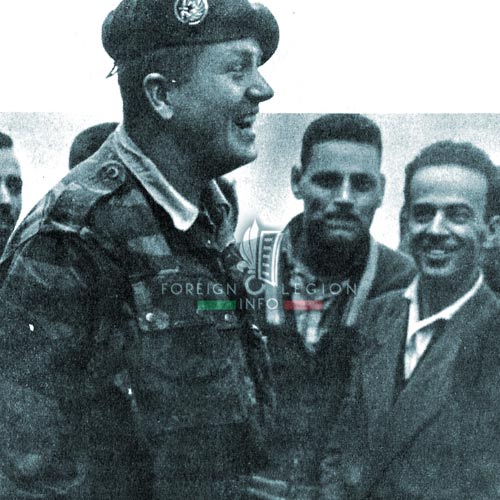
In early September, the 1er REP was sent back to Algiers to finish the battle in the capital. Thanks to intensive raids, three prominent rebel leaders were eliminated. First was Saadi Yacef, the FLN rebels’ military chief of Algiers, on September 24. Lt. Col. Jeanpierre was wounded by a grenade during Yacef’s apprehension. Second was Ali La Pointe, the second most important FLN rebel leader in Algiers who was responsible for many terrorist attacks in the capital. He was killed by 1er REP legionnaires on October 8. Third was Abderrahmane Benhamida, nicknamed Salim El Kaiam, chief of the FLN’s political branch in Algiers. He was captured on October 15. These actions successfully ended the Battle of Algiers and brought peace and safety back to the city. The 1er REP returned to Zeralda.
In late November, the regiment deployed to the Sahara in eastern Algeria, to protect the newly developed oil fields located near Hassi Messaoud. The construction of the installations, as well as a new pipeline to Biskra, was threatened by local rebels. Within a month, dozens of them were killed and 186 rebels were imprisoned. The 1er REP, stationed at Hassi Messaoud, Ouargla, and M’Raier, stayed in the Sahara until January 1958.



1er REP: 1st Foreign Parachute Regiment in 1958
In mid-January, the mission in the Sahara was over. However, instead of Zeralda, the regiment was sent to Northeastern Algeria, to the Guelma and Souk Ahras regions. These were located east of Constantine and north of Tebessa, close to Tunisia. The Battle of the Borders under General Vanuxem started there on January 21. It was a series of large and intense military operations conducted in the regions’ wild mountain ranges and along the Tunisian border, newly reinforced with electric fence barriers. As in 1955 and 1956, the operations focused on the FLN rebels who operated in these regions and crossed the border regularly to their camps in friendly Tunisia, including their supply trains.
In February, two significant battles took place. One on February 12 at Fedj Zezoua, where 47 rebels were killed. The second occurred at Koudiat Megroum on February 26; that day, the 1er REP men killed 149 rebels. However, Lieutenant Georges Maroni was also killed.
Over the course of five weeks, over 600 rebels were killed by the regiment. These results impressed the high command, and the 1er REP was called one of the most elite units of the French Army.
In the meantime, on February 14, the unique Tank Squadron was disbanded. It was a considerably reduced unit at the time, and its men merged with the Motorized Company (CP, a former ER squadron).
In March, the 1er REP saw another two significant battles: one in the Djebel Marioun between March 18 and 19 resulting in the deaths of 118 rebels and 12 legionnaires, and the battle at Chaba Ben Said on March 29, when the 1st Company under Captain Martin killed 70 rebels.
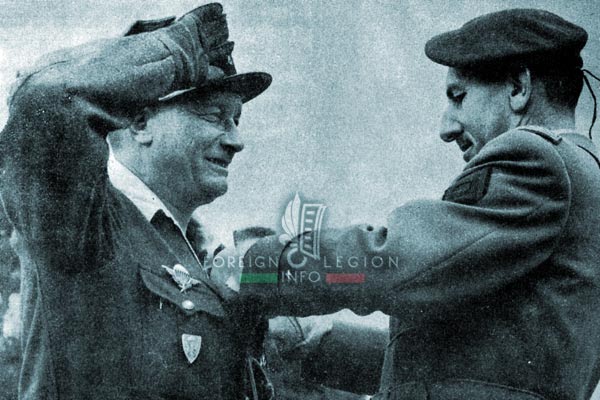
Nevertheless, a tragic loss marred the successful operations. On May 29, Lt. Col. Pierre Jeanpierre was killed while leading his men from a helicopter; the machine was hit by gunfire and crashed. Nobody survived. The regiment lost its father and the Legion an important and remarkable personality. Deputy commander of the original 1er BEP, Pierre Jeanpierre essentially shared the fate of his close friend and the 1er BEP’s commander, Major Pierre Segrétain.
Two days later, the Battle of the Borders was over. In four months, the 1er REP had killed as many as 1,193 rebels. However, 111 men of the regiment fell during the battle, while 278 officers, NCOs, and legionnaires were wounded.
On June 11, the 1er REP returned to Zeralda after having spent six months in the Sahara and near the Tunisian border.
A week later, Colonel Albert Brothier again took command, replacing the fallen commanding officer.
In early July, the regiment returned to maintain order in the capital; it remained there until September.
In mid-July, the 1er REP’s colonel and the color guard participated in the Bastille Day Military Parade in Paris.
In the summer, the camp of the 1er REP in Zeralda was renamed Camp Jeanpierre in honor of their fallen colonel.
In late September, Operation Referendum took place. It involved protecting the streets in Algeria during the successful French National Referendum regarding France’s new constitution and the future status of French colonies. The 1er REP patrolled the streets of Algiers. During the referendum in Algeria, the majority of local Muslims and French settlers voted to be part of France.
In mid-October, the 1er REP moved to the Oran province in northwestern Algeria. The men operated alongside the 2e REI at the Moroccan border, in the Mascara, Ain Sefra, and Figuig regions, until late December.
During their return to Zeralda, a fatal road accident occurred close to the town on December 21. A 1st Company truck slipped on a wet road and crashed into a ravine; Lieutenant René Gastaud and six legionnaires died.
Between December 28 and 31, the 1er REP took part in Operation Couronne II near Berrouaghia, southwest of Algiers; 129 rebels and five legionnaires were killed.


1er REP: 1st Foreign Parachute Regiment in 1959
The 1er REP spent the first half of the year in the mountains of northwestern Algeria, in the Tenes, Orleansville, Frenda, and Cherchell sectors. It carried out several operations there.
In February, the Challe Plan began in Algeria. Named after General Challe, a new commander-in-chief of the French forces in Algeria, the plan was a very successful series of large, offensive military operations aimed at destroying rebels and their armed and political organizations in Algeria and having the French occupy their positions. The 1er REP actively participated. The Challe Plan continued through January 1961.
In mid-February, the 1er REP’s 3rd Company and CA destroyed local rebel leader Menouar and his group of roughly thirty rebels at Tenes, about 125 miles (200 km) west of the capital.
In April and May, Operation Courroie took place in the Cherchell sector of the Ouarsenis mountain range. This was part of the Challe Plan, and the 1er REP participated, alongside the Legion’s 3e REI and 5e REI.
In early May, Lieutenant Colonel Henri Dufour took command of the regiment.
1er REP’s composition in Algeria in May 1959
- Command : Lieutenant Colonel Dufour
- HQ Company : Captain Clementin
- 1st Company : Captain Sergent
- 2nd Company : Captain Ysquierdo
- 3rd Company : Captain Chiron
- 4th Company : Captain Cattelotte
- Combat Support Company (CA) : Captain Roux
- Motorized Company (CP) : Captain Bésineau
On May 14, during a military operation, Adjudant Laszlo Tasnady was killed. A respected NCO within the 1er REP, he was one of the Legion’s three Hungarian senior NCOs killed that May.
In July, the Challe Plan’s Operation Etincelle occurred in the Hodna mountain range of the M’Sila region. The Legion’s 1er REP, 3e REI, 5e REI, and 2e REC took part.
In late July, another large operation of the Challe Plan began: Operation Jumelles. It took place in the Tizi Ouzou sector, in northern Algeria, and consisted of several smaller operations in which the 1er REP, 3e REI, 5e REI, and 13e DBLE were engaged. The operation continued through March 1960. Over 510 rebels were killed, and 220 rebels were captured.
In early August, the Instruction Company 1er REP was activated under Captain Martin. The company’s task was to relieve the 1er RE from parachute training. The company trained fresh legionnaires for both the 1er REP and the 2e REP, a sister unit.
On December 19, Lieutenant Christian Pasteau was killed during Operation Jumelles. A young officer, he fell in his first combat action.
A week later, during the same operation, another officer died: Second Lieutenant Marcel Lemahieu. He had joined the Legion as a ordinary legionnaire in 1947.
In 1959, 972 rebels were killed by the 1er REP; the regiment also lost 42 men.



1er REP: 1st Foreign Parachute Regiment in 1960
Week of Barricades. The beginning of the year was marked by demonstrations in Algeria’s capital during the last week of January. Organized by pro-French public figures, the protests were a response to General de Gaulle’s proclamation about Algeria’s self-determination, as well as his dismissal of General Massu. Commander of the French forces in Algiers at the time, Massu had criticized de Gaulle’s policy in Algeria. Several military units, including the 1er REP, were sent to restore order. However, the legionnaires sympathized with the organizers who, in May 1958, had helped General de Gaulle to gain power. Ironically, de Gaulle allowed the organizers of the Week of Barricades to be sentenced to 10 years in prison which would cause future problems.
Throughout May and June, the regiment carried out several operations in the Hodna and Bou Saada regions. Among them were Operation Flammeche and Operation Pamphile.
In late June, the 1er REP men moved to the Collo sector in the Philippeville region of the northeastern part of the country. They conducted counter-guerrilla operations there. Notably, the 2e REP was stationed in Philippeville (Skikda today).
Between late July and late September, the 1er REP participated in Operation Cigale in the Ouarsenis, around the town of Vialar (Tissemsilt now). At least 115 rebels were killed.
1er REP’s composition in Algeria in September 1960
- Command : Lieutenant Colonel Dufour
- HQ Company : Captain Bernard
- 1st Company : Captain Sergent
- 2nd Company : Captain Simonot
- 3rd Company : Captain Estoup
- 4th Company : Captain Cattelotte
- Combat Support Company (CA) : Captain Ponsolle
- Motorized Company (CP) : Captain de la Forest Divonne
The 1er REP was composed of 1,285 officers, NCOs and legionnaires.
Between October 5 and November 19, Operation Ariege (the first phase of the larger Operation Trident) took place in the Setif and Batna regions in northeastern Algeria. Both towns were former garrisons towns of the 3e REP, dissolved in late 1955. Over 110 rebels were killed during the operation.
On November 10, a fierce battle occurred during Operation Ariege, near Batna. Lieutenant Godot and his 1st Company, 1er REP were involved. During the battle, nine rebels were killed, as were 11 legionnaires; six legionnaires were wounded.
On December 5, Colonel Henri Dufour left the regiment. He was replaced by Lt. Colonel Maurice Guiraud, who arrived in mid-December.

1er REP: 1st Foreign Parachute Regiment in 1961
1er REP Officers’ Revolt. In early January, a French referendum was held on the matter of Algeria’s self-determination, as ordered by French President de Gaulle. In Algeria, 70% of voters voted for independence. The referendum was seen as a provocation and many Legion officers opposed it. The same day, four 1er REP company commanders revolted (Sergent – 1st Coy, Simonot – 2nd Coy, Ponsolle – CA, de La Forest Divonne – CP). This was a unique, extraordinary issue, a response to the referendum. While stationed near the Tunisian border, they refused to carry out a military operation. Their stated reason was that they didn’t want to see their men killed for no reason. The revolt resulted in the captains being transferred outside the Legion. Other officers left the regiment as well.
1er REP’s composition in Algeria in late January 1961
- Command : Lieutenant Colonel Guiraud
- HQ Company : Captain Bésineau
- 1st Company : Captain Rubin de Cervens
- 2nd Company : Lieutenant Picot d’Alignies d’Assignies
- 3rd Company : Captain Estoup
- 4th Company : Lieutenant (later Captain) Bonelli
- Combat Support Company (CA) : Captain Carreté
- Motorized Company (CP) : Lieutenant Durand-Ruel
In mid-January, the regiment returned to Zeralda. The same month, Major Hélie de Saint Marc rejoined the 1er REP to boost the unit’s morale. He became its second-in-command.
Between late January and mid-April, the regiment conducted operations in the regions of Bougie, Djidjelli, and El Milia, situated along the coast of the Mediterranean Sea in northeastern Algeria. Almost 200 rebels were killed, wounded or imprisoned.
During the operations, several intense clashes with rebels took place. One of them occurred close to Mila, in the Djidjelli region, from January 31 to February 1; 21 rebels were killed. The second one took place near Kherrata, in the Bougie region, in late February. This time, 38 rebels were killed.
In mid-April, the 1er REP returned to Zeralda. The colonel went on leave and returned to France for several days. Major Hélie de Saint Marc replaced him.
Generals’ Putsch in Algiers. A week later, a coup d’état took place in the capital of Algeria, organized by four retired French high-ranking generals. These were almost the same figures who had helped General de Gaulle gain power in May 1958, via a similar putsch in Algiers. Now, because of his acceptance of Algeria’s independence, they saw de Gaulle as a betrayer of France, French settlers in Algeria, and the French soldiers who had fallen during the Algerian War. Many in the military believed that the Algerian rebels could have been quickly defeated if the political will existed to do so.
Major Hélie de Saint Marc with his 1er REP joined the putsch, and the unit became one of its most active participants. The men took control of several strategic points in Algiers and maintained order in the capital.
However, three days later, on April 25, the putsch failed. The following day, the regiment returned to Zeralda. In the afternoon, the camp was besieged by units loyal to de Gaulle.
On April 27, Lt. Colonel Guiraud arrived from France to replace Major Hélie de Saint Marc who had been arrested. Later, Guiraud moved to Sidi Bel Abbes, the Legion’s HQ. In the meantime, 1er REP officers were arrested or detained. Company commanders were sent to the High Military Tribunal and sentenced to one to two years in prison; their sentences would be suspended. 1er REP lieutenants were released without tribunals.
In the afternoon, at 05:30 p.m. (17.30), the 1er REP men left Camp Jeanpierre for Thiersville (today’s Ghriss), a small town in northwestern Algeria, with a former military air base. During the movement, dozens of legionnaires deserted; many of them continued their fight for French Algeria as illegal partisans within the OAS (Secret Army).
Liquidation Detachment. In Zeralda, only one detachment remained, comprising around 100 men under Captain Caumont. They were appointed as liquidators whose mission was to execute the unit’s dissolution. They had to collect all documents, weapons, munitions, etc., and handle the subsequent cleanup operations. The detachment, less 60 men who had left the camp for Thiersville on April 29, was later reinforced by a team from the 1er RE. Lt. Col. Guiraud, after his return from Sidi Bel Abbes, also took part in the liquidation of his unit. The liquidators remained at the camp until late May.
1er REP’s dissolution. On April 30, Camerone Day, the 1er REP was officially dissolved, as a punishment for the unit’s participation in the putsch. Its last Camerone Day took place at Camp Jeanpierre in Zeralda. The small ceremony was organized by Lieutenant Soum, one of the very few unarrested 1er REP officers (on April 29, he had returned from his official leave in France).
Meanwhile, in Thiersville, between April 30 and May 3, 1er REP men got their new assignments in other Legion units (mainly the 1er RE). A special 1er RE detachment carried out this mission.
During the six years in Algeria, from 1955 to 1961, the 1er REP (and 1er BEP) men killed, wounded, or captured 3,507 rebels. The regiment was seen as the elite of the French Army. Having twice survived its annihilation during the First Indochina War, the unit was ultimately felled by a political decision. The 1er REP has never been reactivated. In Algeria, it lost 7 officers, 44 NCOs, and 247 legionnaires.


1st Foreign Parachute Regiment’s hymn
The regimental song of the 1er REP: Contre les Viets
———

You can support this website at any time through our store. Thank you.
EU-based readers can visit our EU-based shop, to avoid import charges.
Please note that the 1er REP design is available in the U.S. Store only.
———
Main information sources:
Képi blanc magazines
Foreign Legion annual bulletins
Jean-Luc Messager and collective: Légionnaires parachutistes (L’Esprit du Livre, 2008)
Pierre Montagnon: Les parachutistes de la Légion (Pygmalion, 2005)
Pierre Montagnon: Histoire de la Légion (Pygmalion, 1999)
Pierre Sergent: Je ne regrette rien (Librairie Fayard, 1972)
Alain Gandy: La Légion en Algérie (Presses de la Cité, 1992)
Henri Le Mire: L’épopée moderne de la Légion (SPL, 1977)
Fanion Vert et Rouge (Fr)
Google.com
Wikipedia.org
———
More about the history of Foreign Legion paratroopers:
2nd Foreign Parachute Battalion
History: 2nd Foreign Parachute Regiment
3rd Foreign Parachute Regiment
Parachute Company of 3e REI
1st Heavy Mortar Foreign Parachute Company
———
The page was updated on: October 24, 2023