
The Battle of Rachaya (November 18–24, 1925) illustrates the heroic resistance of the 4th Squadron, 1st Foreign Cavalry Regiment and the Tunisian Spahis in the citadel of Rachaya, in Lebanon, then besieged by Druze forces vastly superior in number. The battle remains one of the symbols of honor and courage to the traditions of the French Foreign Legion and helped to check the spread of the Druze uprising into Lebanon.
—
L'article en français : Bataille de Rachaya (1925)
—

Background: French Mandate and the Druze Revolt
After the end of the First World War, France obtained an international mandate over the Levant, a former possession of the Ottoman Empire, covering the territories of present-day Syria and Lebanon. In the summer of 1925, an uprising broke out in southern Syria among the Druzes, a small Levantine ethnoreligious community with a distinct monotheistic faith. Units of the French Foreign Legion took part in operations to re-establish French control and, in September, inflicted a severe defeat on the rebels at Messifré, which allowed France to occupy the Druze stronghold of Soueida. However, the evacuation of this town by French troops, due to water and supply issues, restored the insurgents’ confidence. After briefly seizing control of Damascus, the capital of the State of Syria (one of several semi-autonomous entities created by France), they were driven back, but heavy fighting on the outskirts of the city at the end of October further fueled anti-French hostility.
By November, the rebels already controlled part of the territory west of Damascus, up to Mount Hermon in the Anti-Lebanon range on the Syrian–Lebanese border. There, Zayd al-Atrash, one of the Druze rebel leaders and brother of Sultan al-Atrash, organizer and leader of the Druze revolt of 1925–1927, launched an insurrection to link up with the Lebanese Druze, seized several positions, including Marjayoun, and set up a Druze government. The extension of the revolt into Lebanon was judged unacceptable in Paris, as it risked turning a local uprising into a regional conflict.
The Cavalry Group and the Garrison of Rachaya
To prevent the revolt from spreading into Lebanon, the French authorities sent a cavalry group across the Anti-Lebanon range in mid-October. Led by Colonel Capitrel, its mission was to monitor the Hermon region, maintain order in the Christian villages, and intimidate Druze communities that might be tempted to rise up. The group brought together three different components: Spahi cavalry (colonial light cavalry units of the French Army, originally recruited in North Africa), locally recruited Lebanese auxiliaries, and Foreign Legion cavalry. The latter was represented by the 4th Squadron, 1st Foreign Cavalry Regiment (1er REC). The squadron had already distinguished itself at Messifré, where it had been cited in Army Orders, but had suffered heavy losses: made up largely of former anti-Bolshevik fighters from the “White armies” of the Russian Civil War of 1918–1921, it had been reduced from 179 men to around one hundred. Re-formed at Rayak in Lebanon and still below its original strength, it was commanded by Captain Landriau, with Lieutenants Gardy, Castaing, and de Médrano as platoon leaders.
The cavalry group established itself at Rachaya, in the Anti-Lebanon range, about four miles (7 km) north of Mount Hermon. Rachaya was then a mixed Lebanese village with some 3,000 inhabitants, both Christians and Druze. At the beginning of November, Colonel Capitrel left for France and his deputy, Captain Granger of the Spahis, took command. On November 5, as the situation deteriorated and an attack seemed more likely, the exposed bivouac in the lower part of the village was abandoned and the group moved into an old Frankish fortress dating from the time of the Crusades that overlooks Rachaya. A palace dominating this so-called citadel, built there by the prominent Shihab family in the 18th century, was chosen as the group’s headquarters.
The French garrison, commanded by Captain Granger, consisted of a squadron of the 12th Tunisian Spahi Regiment (12e RST) – available sources differ on whether it was the 1st, 3rd, or 4th Squadron – with about 135 men under Captain Cros-Mayrevieille; around one hundred legionnaires from the 4th Squadron 1er REC under Captain Landriau; a reduced machine-gun platoon from the 12e RST with one lieutenant and 35 gunners; and about 80 Lebanese gendarmes under Lieutenant Tiné. In all, the garrison in the citadel numbered roughly 350 men.
Meanwhile, after the capture of Marjayoun, the rebels of Zayd al-Atrash occupied several localities to the south and west of Mount Hermon and drew dangerously close to Rachaya. They planned to extend their government to the village, which they intended to place under the authority of another Druze leader, Dervich.


Rising Threat and Defensive Preparations
Daily reconnaissance patrols then reported enemy gatherings in the Rachaya area and regularly exchanged fire with hostile bands. Intelligence reports converged on the same conclusion: three groups, totaling about 3,000 men, were preparing to attack Rachaya before moving on toward the approaches to Lebanon that the position controlled. Several indications confirmed the threat – the closing of markets, young Druze men leaving the village to reinforce the rebels, and panic among Christians seeking refuge deeper inside Lebanese territory. The remaining Druze inhabitants began to doubt the arrival of French reinforcements and grew increasingly defiant, refusing to provide information and making no secret of their sympathy for the rebels.
In response, the citadel was immediately placed in a systematic state of defense. The northern, western and eastern sides of the fortress were relatively secure, thanks to their elevation above the surrounding ground. On the southern side, however, the ground outside the walls rose slightly again into a rocky hill that dominated even this highest part of the defenses and overlooked the citadel. Priority was given to securing this weaker perimeter so that the enemy could not approach the fortress easily or break through its two entrances, which were located to the southeast (main entrance) and southwest.
Positions for machine guns, light machine guns, and rifle grenades were prepared, and the windows of houses and cellars facing outward were bricked up to prevent them from being used as firing positions or entry points by the attackers. Chicanes – staggered barriers designed to slow and break up an assaulting crowd – were installed at both entrances. A barbed-wire entanglement was laid around the position and reinforced on the southern side, where the main enemy effort was expected.
Work then focused on the internal strongpoints that would have to sustain the defense in the event of a breach. In the northern sector, the palace serving as headquarters and the adjacent houses were turned into a strongly fortified redoubt to hold the garrison’s reserves. A medieval tower, a key point dominating the southwestern corner, was equipped with an optical signaling post (using a heliograph or searchlight). From there, observers in the tower could send Morse-coded light signals to the command post in the northern part of the citadel, reporting all information gathered on the enemy. An underground tunnel dug into the surrounding wall, roughly 30 feet (9 m) thick, linked the tower to the rest of the fortress.
At the same time, food and ammunition were stockpiled in anticipation of a siege: about ten days’ worth of provisions and a reserve of water in cisterns. The garrison also had 22,000 cartridges, 240 hand grenades (a significant number of them considered defective, which made the garrison wary of wasting them in minor skirmishes), 1,800 Viven-Bessières rifle grenades (VB) and 160 signal flares. The command kept six homing pigeons as a last resort for communications.
On November 15, the situation was considered alarming and an attack seemed imminent. While French intelligence estimated the enemy’s strength at around 3,000 men, local rumor – deliberately spread by Druze sympathisers – inflated this figure to 4,000 or 5,000 in order to intimidate the garrison and the Christian villagers. On November 16, a patrol from the 1er REC briefly engaged the enemy and killed one rebel.


November 19: The First Losses
On November 19, a platoon from the 1st Foreign Cavalry Regiment, commanded by Lieutenant Gardy – the future commander of the French Foreign Legion – left the citadel on a reconnaissance toward the southwest, in the direction of Aïn Hircha and Beit Lahia, referred to as Beyt el Heba in contemporary sources. Reinforced by a group of Lebanese gendarmes, the detachment was tasked with monitoring Druze movements and securing the approaches to Rachaya. Gardy advanced toward the small village of Tannoura with five legionnaires and three gendarmes, in order to gain a clearer view of the ground and enemy movements. However, at the same time, the rest of the platoon was attacked on the northern heights of Beit Lahia by 300 to 400 Druze fighters coming from the east. The lieutenant and his forward party were cut off and in turn came under fire, with almost all their horses killed. While the bulk of the platoon, sheltered by the folds of the ground and supported by covering fire, managed to disengage relatively easily and return to Rachaya, Gardy’s group was forced to fall back on foot, over difficult terrain, toward Beit Lahia.
The small group was soon in a very bad way. Two Lebanese gendarmes went missing, and Legionnaire Popoff* was killed. Legionnaire Stitchinsky was gravely wounded. Legionnaire Borissoff, hit in the shoulder, was unable to continue fighting. Only two legionnaires and one gendarme remained fit for combat alongside the lieutenant. Stitchinsky died in a house in Beit Lahia, while the Druze were already in the streets. With the help of Christian supporters, the group managed to leave the village to the west and reach Kfar Mishki, some three miles (5 km) to the northwest. There, Borissoff was entrusted to the care of a Christian family. Lieutenant Gardy and the three men with him succeeded in returning to the citadel the next day, not without difficulty.
At the same time, on the 19th, another reconnaissance – a platoon under Sergeant Guignard from the 12e RST squadron – was also attacked and surrounded. Another spahi platoon and the entire Lebanese gendarmerie were sent as reinforcements. The spahis soon withdrew without suffering any losses. As for the gendarmerie, the available sources indicate that all the three officers of this unit, including the French Lieutenant Tiné, were killed and the Lebanese auxiliaries scattered. The circumstances of their deaths and the subsequent dispersal of the troops remain poorly documented, however.
* At the time, at least three men named Popoff were serving with the 4th Squadron – a sergeant, a corporal, and this legionnaire – which complicates the identification of some casualty lists.

Fighting of November 20–22
On the evening of November 19, Captain Granger received orders to hold the citadel at all costs. The higher command believed that the fall of Rachaya risked triggering an uprising in Lebanon and in Beirut, its capital, which explains the decision to defend the position with the greatest firmness. To avoid dispersing his forces, the captain cancelled all reconnaissance patrols. At that point, he had only the two squadrons and the machine-gun platoon left to defend the citadel, a total of roughly 270 men. The scattered Lebanese auxiliaries are no longer mentioned in accounts of the fortress’s defense. In the meantime, three Druze groups, estimated at between 2,000 and 3,000 men, were preparing to launch an assault.
On November 20, the morning remained quiet. To save the water stored in the cisterns, the horses were taken earlier than usual to drink at the village watering place, around 1 p.m. (13.00 h). At about 3:30 p.m. (15.30 h), as the last platoon was preparing to return to the citadel, it came under fire from Druze fighters but managed to get back inside. The gunfire immediately triggered a fusillade from the surrounding rooftops and ridgelines. The citadel found itself encircled and its gates were closed. Two hours later, the Druze launched an assault on the main tower after cutting the telephone line that linked the citadel with higher headquarters outside the village. The legionnaires held the most exposed points and, on the southern face, light machine guns and heavy machine guns broke up the first waves, repelling the initial attack.
On November 21, with all communications cut, the garrison commander had only homing pigeons left to communicate with higher headquarters. At dawn, under covering fire, the Druze occupied the rocky hill and concentrated their attacks on the southern face, judged to be a weak point. They reached the barbed-wire entanglements and eventually cut through them. The defenders – legionnaires – returned fire and drove back the assaults. By evening, the Legion squadron alone had already suffered four killed and 15 wounded. However, the enemy ultimately failed to breach the defenses and their efforts appeared to be flagging.
During the night, the enemy suffered losses from VB rifle grenades and interdiction fire from machine guns.
At dawn on November 22, the Druze renewed their attack against the tower and the southern sectors. Accurate fire from their riflemen restricted the defenders’ ability to reply from the tower. At 8:30 a.m., Captain Granger, the citadel’s commander, was fatally shot in the head; he was replaced by Captain Cros-Mayrevieille from the 12e RST squadron. Around noon, a fierce grenade attack struck the southern face and knocked out several automatic weapons near the main gate, but the legionnaires held their positions. In the afternoon, despite the pressure, the defenders stood firm and, by about 3 p.m. (15.00 h), the Druze gave up and withdrew. The streets of the village were already strewn with their dead. The defensive positions remained intact, but ammunition was running low and orders were given to conserve it, while exhaustion weighed on a garrison that had been engaged for nearly 48 hours.
A message weighted and dropped by an aircraft announced the arrival of a relief column on the 24th, which revived hopes. The following night, however, enemy reinforcements arrived – at least 1,000 additional men, including about 500 horsemen. Later intelligence showed that around 4,000 Druze ultimately took part in the attack on Rachaya.


November 23: The Decisive Day
November 23 was a decisive day for the besieged garrison of Rachaya. At 5 a.m., Druze rebels launched a grenade attack against the southern side and the tower with the intention of capturing the position. In the tower, Sergeant Popoff, the last defender, fought on, throwing his remaining grenades until he was mortally wounded. The attackers then seized the tower and beat back a counterattack by the legionnaires of Lieutenant de Médrano, who was himself wounded.
Around mid-morning, the Druze gained control of the small entrance, in spite of the resistance of Lieutenant Castaing who, with his legionnaires, held the first floor of a house controlling the access. The main gate was also subjected to a violent attack, held for hours by Warrant Officer Gazeau and three legionnaires. They were occupying and defending a position built above the entrance with grenades and automatic weapons. Gazeau, commander of the squadron’s headquarters platoon, was one of the unit’s most seasoned legionnaires. He had already distinguished himself at the Battle of Messifré, where he kept fighting despite being wounded twice.
The Druze then discovered the tunnel in the tower and used it, appearing in the courtyard. A machine gun caught them and for a time stopped the infiltration, until fire from the tower occupied by the enemy put the gun crew out of action. Sergeant Bisseroff and a legionnaire managed to get to the weapon, bring it back into action and briefly stabilize the situation.
Around 10 a.m., a new assault on the main entrance resulted in the death of Warrant Officer Gazeau and forced the defenders to abandon the position and fall back.
Captain Cros-Mayrevieille, commanding the garrison, then sent his last pigeon. In his message, he described a very critical situation and urgently requested the dispatch of an infantry battalion or, failing that, a cavalry regiment, while affirming that everyone would do his duty to the very end.
The day continued as a succession of close-quarters engagements in which Lieutenants Gardy, Castaing, and de Médrano from the Legion, and Lieutenant Livary from the Spahis, distinguished themselves in further counterattacks, using sabers, bayonets, and grenades. Legionnaire Kapf also inspired his comrades – already wounded, he picked up and threw back a grenade that had landed in the middle of his group. Wounded a second time and bandaged only roughly, he went back into action, leading a counterattack armed with a saber.
Throughout the early afternoon, the Druze, dug in inside a house next to the main gate, repeatedly assaulted the courtyard. Around 3 p.m. (15.00 h), aircraft bombed the Druze positions with limited effect because of their proximity to the French lines, but the enemy attack began to lose momentum.
Despite this slowdown, the situation remained critical. By the end of the day, the southern part of the citadel had to be abandoned. The survivors retreated to the redoubt set up in the northern part, where the wounded were gathered. The garrison lost around 40 percent of its personnel and almost all of its horses. In Gardy’s platoon, out of 22 men, only five able-bodied legionnaires remained, with the wounded continuing to fire despite their injuries.
In the early evening, around 5 p.m. (17.00 h), the grenades were exhausted and only one crate of cartridges remained for the two squadrons. The ammunition was distributed among the survivors, about thirty rounds per man. The Druze launched another assault in an attempt to annihilate the garrison, but once again they were driven back in hand-to-hand combat. Heavy losses among the legionnaires and spahis forced the defenders to contract their front around the redoubt, where they prepared to hold out until they were completely overwhelmed. Finally, around 8 p.m. (20.00 h), the sentries saw a green flare rise into the sky, and four shells exploded in the northern part of the village – the relief column was now only a few miles away. Discouraged and exhausted, the Druze gave up attacking during the night.


November 24: The End of the Battle
At 8 a.m. on November 24, the defenders of Rachaya repelled a final attack, in which only the most determined elements returned to the assault, while the bulk of the Druze forces began to withdraw eastward toward Ayha. Ammunition was down to no more than about fifteen rounds per man, which forced the garrison to maintain a strictly economical defense. Two more legionnaires were killed and several others wounded. After this last effort the fighting around the citadel died down, with only sporadic shots from the retreating Druze, and the garrison settled into a tense wait for the promised reinforcements.
Around 11 a.m., the 1st Squadron of the 6th Spahi Regiment (6e RS) reached the first houses of Rachaya. The firing of a gun to the southwest announced the approach of a second relief column, formed by a battalion of the 21st Algerian Tirailleur Regiment (21e RTA) under Major Loynet. At 1:30 p.m. (13.30 h), while Loynet’s troops occupied the southern spur overlooking the village, the squadron of the 6e Spahis entered the citadel and linked up with the garrison – an emotional moment marked by the meeting between Captains Stocklé and Landriau.
Casualties and Honors
Of the roughly 4,000 Druze fighters engaged against Rachaya, French estimates put their losses at around 400 killed. On the defenders’ side, contemporary summaries gave a figure of about 20 killed and 80 wounded for the garrison during the fighting around the citadel itself, a number that does not include all losses suffered in the reconnaissance actions of November 19. The 4th Squadron 1er REC officially recorded 12 dead and 34 wounded. The Mémoire des Hommes database of the French Ministry of Armed Forces, however, lists a few additional names (while omitting others) for the 1st Foreign Cavalry Regiment at Rachaya; taking these into account brings the total number of dead for the 4th Squadron between November 19 and 24 up to 16.
The 1er REC’s wounded included Sergeant Bisseroff and Corporals Popoff, Gerhard, and Lvoff, the latter dying on the 26th. Lieutenant Gardy was seriously wounded, whereas de Médrano and Castaing sustained only minor wounds. The spahis, less exposed to close combat, lost seven men, while the Lebanese gendarmerie had already suffered officer casualties on November 19. Material losses were considerable, with the 4th Squadron’s 107 horses killed out of 108.
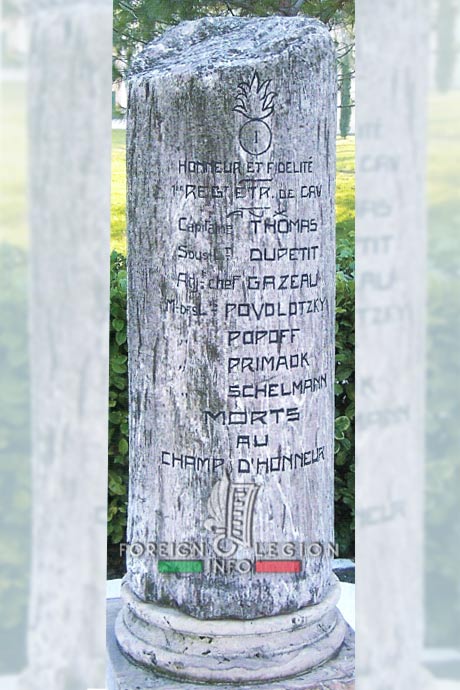
1er REC men killed in Rachaya in November 1925
- Warrant Officer GAZEAU Léon (France)
- Sergeant POPOFF Julien (Russia)
- Corporal HOFFMANN Jules (Russia)
- Corporal DUGAST Marie (France)
- Legionnaire BORISOFF (Russia)
- Legionnaire DREIER Wilhelm (Switzerland)
- Legionnaire ENOCHIN Lew (Russia)
- Legionnaire FROMM Joseph (Germany)
- Legionnaire ISVARINE Basile (Russia)
- Legionnaire IVANOFF Basil (Russia)
- Legionnaire KUHLMANN Conrad (Germany)
- Legionnaire LIMARD André (France)
- Legionnaire POPOFF Nikita (Russia)
- Legionnaire STITCHINSKY Alexandre (Russia)
- Legionnaire SOLOVIEFF (Russia)
- Legionnaire TOPPS (origin not specified)
At the end of the fighting, the actions of the garrison and of the 4th Squadron were officially recognized. General Gamelin’s Order No. 393 of November 28, 1925, cited each of the two squadrons defending Rachaya in Army Orders:
“Charged with the defense of the citadel of Rachaya, it repelled from November 21 to 24, 1925, numerous assaults driven as far as hand-to-hand combat. It held out to the last cartridge, thus allowing the relief column to arrive. Within these walls, glorious remnants of our forebears, it inscribed a legendary page to rival the finest feats of arms of our distant wars.”
This second citation earned in the Levant by the 4th Squadron 1er REC in less than two months entitled it to wear the fourragère in the colors of the Croix de Guerre (War Cross) for Foreign Theaters of Operations. In addition, the 4th Squadron received the Lebanese Order of Merit.


Conclusion
The defense of Rachaya in November 1925 stands out as a tactical success achieved under particularly difficult siege conditions, in which the French Foreign Legion and the Spahis held their positions until the arrival of the relief columns. Through its duration and the cohesion of its defenders, the engagement halted the immediate spread of the uprising toward Lebanon, kept the road to Beirut under control and restored a more favorable balance of forces for the French troops in this sector.
In strategic and political terms, the outcome of the battle proved decisive for the continuation of operations: Druze initiative was checked, the Lebanese front was stabilized and French authority was consolidated in the short term, allowing operations against the revolt to continue until order was restored in 1926.
For the 1er REC, the Battle of Rachaya became a key reference point in the regiment’s collective memory and its own “Camerone” – a heroic last-stand defense carried through to the very end, following the example of the legionnaires in Mexico in 1863.
After the squadron returned to Tunisia at the end of 1926, a stone war memorial dedicated to the dead of the Levant was erected on the regiment’s base at Sousse. It later came to symbolize all cavalry legionnaires killed in action. Today, this memorial stands in the 1er REC camp at Carpiagne, linking the regiment’s current generation of cavalrymen to the small garrison that held out at Rachaya in November 1925.
By a twist of fate, the 1st Foreign Cavalry Regiment is still serving in Lebanon a hundred years after the battle, this time as part of the United Nations Interim Force in Lebanon (UNIFIL). In November 2025, it therefore took the opportunity to mark the centenary of the Battle of Rachaya on the very ground where its men had fought in 1925.



———
Main information sources:
Képi blanc magazines
Légion Etrangère magazines
Le 1er Régiment Étranger de Cavalerie, Historique et Combats (FASQUELLE Éditeurs, 1947)
J. Brunon, G.-R. Manue, P. Carles: Le Livre d’Or de la Légion (Charles-Lavauzelle, 1976)
Jean-Charles Jauffret: L’idée d’une division de Légion étrangère et le Premier régiment étranger de cavalerie, 1836-1940 (Centre d’histoire militaire et d’études de défense nationale, 1978)
Historique du 1er Régiment étranger de cavalerie 1921-1982 (Képi blanc, 1983)
Alain Gandy: Royal Etranger: Légionnaires cavaliers au combat (Presses de la Cité, 1985)
Mémoire des Hommes (Fr)
Wikipedia
———

———
Learn more about the Foreign Legion history:
1863 Battle of Camerone
1903 Battle of El Moungar
1908 Battle of Menabha
1911 Battle of Alouana
1930 Battle of Bou Leggou
1933 Battle of Bou Gafer
———
The page was updated on: November 27, 2025