
The DOCUMENTS series returns with a new item. Today we feature a presentation folder containing the citation commemorating the 1st Battalion 2e REI, and one of the last hard-fought actions of the Rif War in Morocco: the battle for Djebel Iskritten in May 1926.
When France established its Protectorate over Morocco in 1912, Spain received a separate zone in the north of the country, including the rugged Rif Mountains. Even within the French zone, however, large mountainous regions remained beyond the effective reach of both the Sultan’s government and the French administration. The French Army therefore conducted a prolonged series of campaigns, known as the “Pacification of Morocco”, to bring resistant tribes under control. The Foreign Legion played a major role in these operations, inluding its 2nd Foreign Infantry Regiment (2e REI), permanently stationed in the country from the early 1920s.
The Rif War transformed the situation. In 1921, Riffian tribesmen led by Abd el-Krim destroyed a Spanish army at Annual, and went on to establish a de facto independent state in the Spanish-controlled north. In the spring of 1925, his forces carried the conflict into the French zone, overrunning outposts south of the Rif and advancing toward Fez, the old imperial capital, and Taza, which guarded the main route linking western Morocco with French Algeria. France was drawn into full-scale war. After a year of heavy fighting and failed peace negotiations, French and Spanish forces launched a joint offensive in May 1926 to break into the central Rif and end the war.
It was during this offensive that the 1st Battalion 2e REI, under Major Gérard, went into action on May 11. Djebel Iskritten, a strongly defended mountain position, lay directly across the French line of advance. Its assault, and the days of hard fighting that followed, also allowed the 2e REI’s neighboring 3rd Battalion to press forward with its own attack. The fighting at Iskritten formed part of the decisive final stage of the Rif War, and the conduct of both battalions there earned them citations à l’ordre de l’armée (at the Army level), the highest level of citation in the French Army. About two weeks later, on May 27, Abd el-Krim surrendered to the French, bringing organized Riffian resistance to an end.
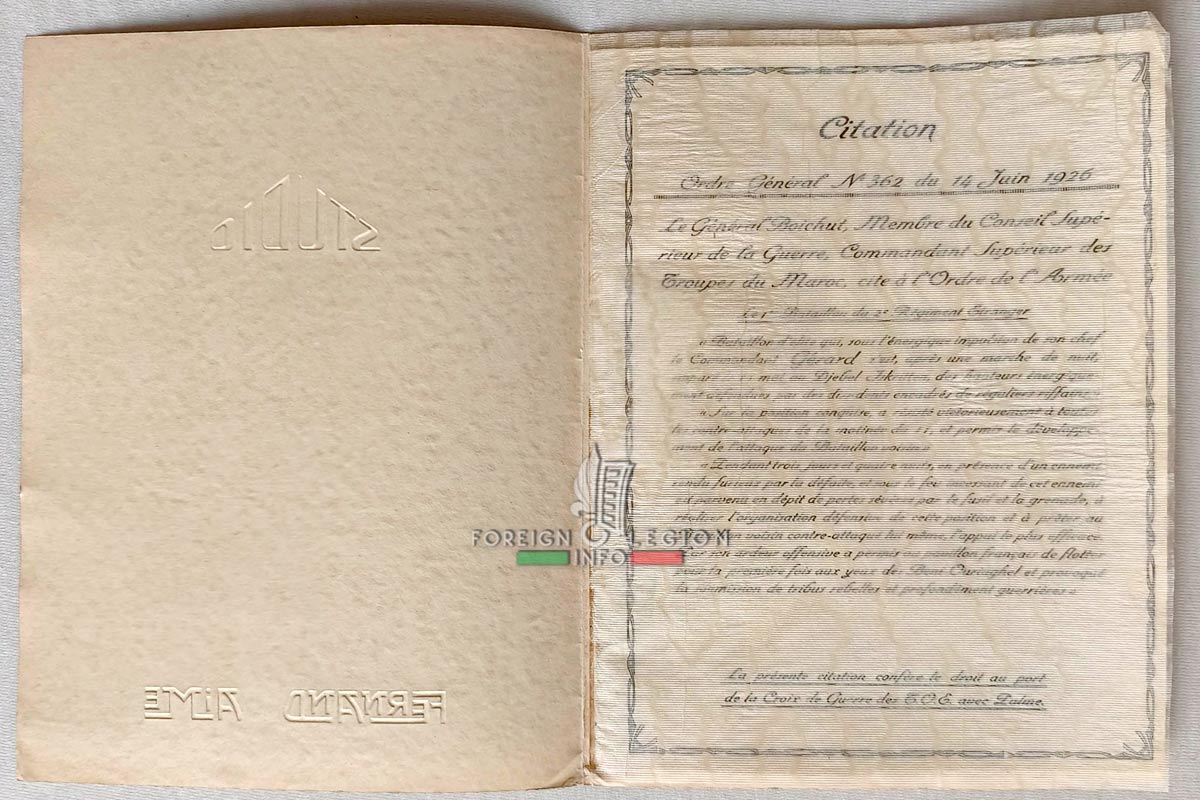
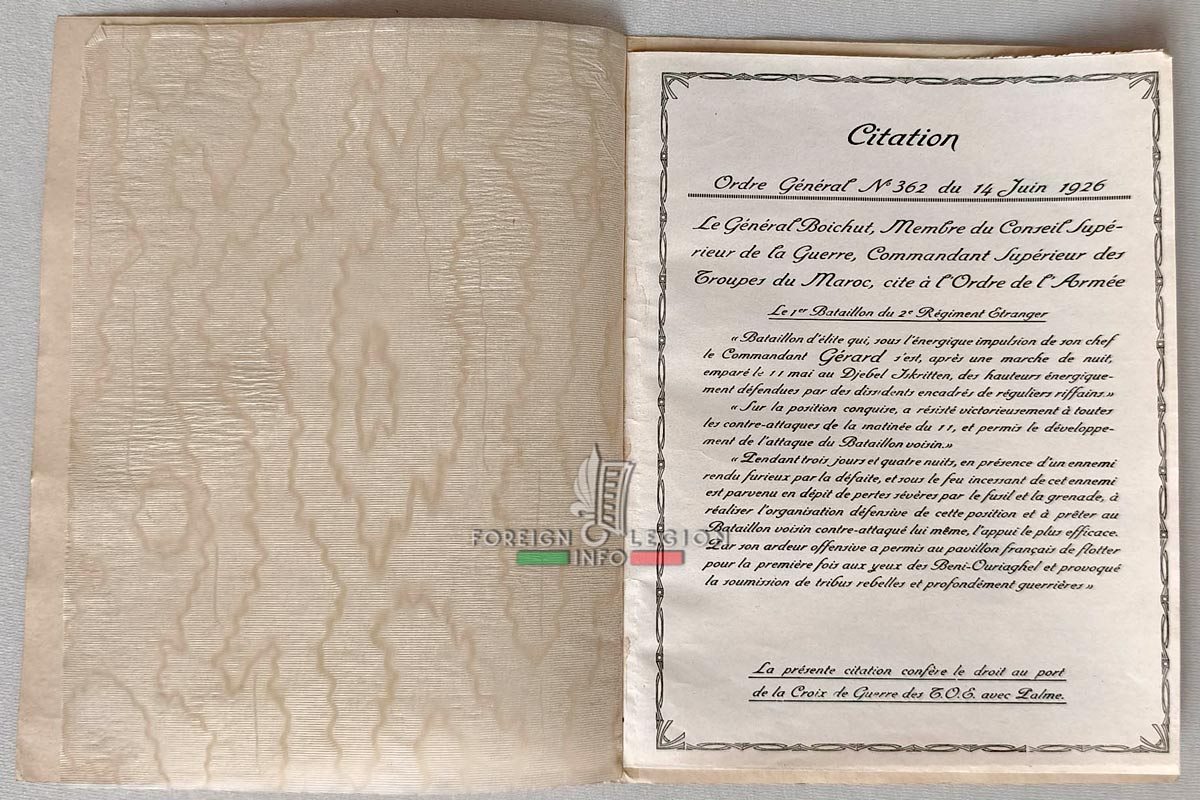
The citation awarded to the 1st Battalion 2e REI describes the action at Iskritten in the words of the time:
General Order No. 362
June 14, 1926General Boichut, Member of the Superior War Council and Commander-in-Chief of the Troops in Morocco, cites in Army Orders:
The 1st Battalion, 2nd Foreign Regiment
“An elite battalion which, under the vigorous leadership of its commander, Major Gérard, after a night march seized, on May 11 at Djebel Iskritten, heights strongly defended by rebel tribesmen led by Riffian regulars.
“Having taken the position, it successfully resisted every counterattack launched during the morning of May 11 and enabled the neighboring battalion to develop its attack.
“For three days and four nights, in the face of an enemy enraged by defeat and under its continuous fire, the battalion succeeded, despite severe losses from rifle fire and grenades, in organizing the defenses of the position and in rendering the most effective support to the neighboring battalion, which was itself under counterattack. Through its offensive spirit, it enabled the French flag to fly for the first time in sight of the Beni-Ouriaghel and brought about the submission of rebellious and fiercely warlike tribes.”
This citation carried the award of the Croix de Guerre des T.O.E. with Palm.
For the record, the Beni-Ouriaghel were Abd el-Krim’s own tribe and the core of Riffian resistance, which gave this action particular symbolic weight. The Croix de Guerre des T.O.E. (Théâtres d’Opérations Extérieurs), or War Cross for Overseas Theaters of Operations, recognizes acts of bravery in military operations outside metropolitan France. The palm on its ribbon indicates a citation at the Army level.
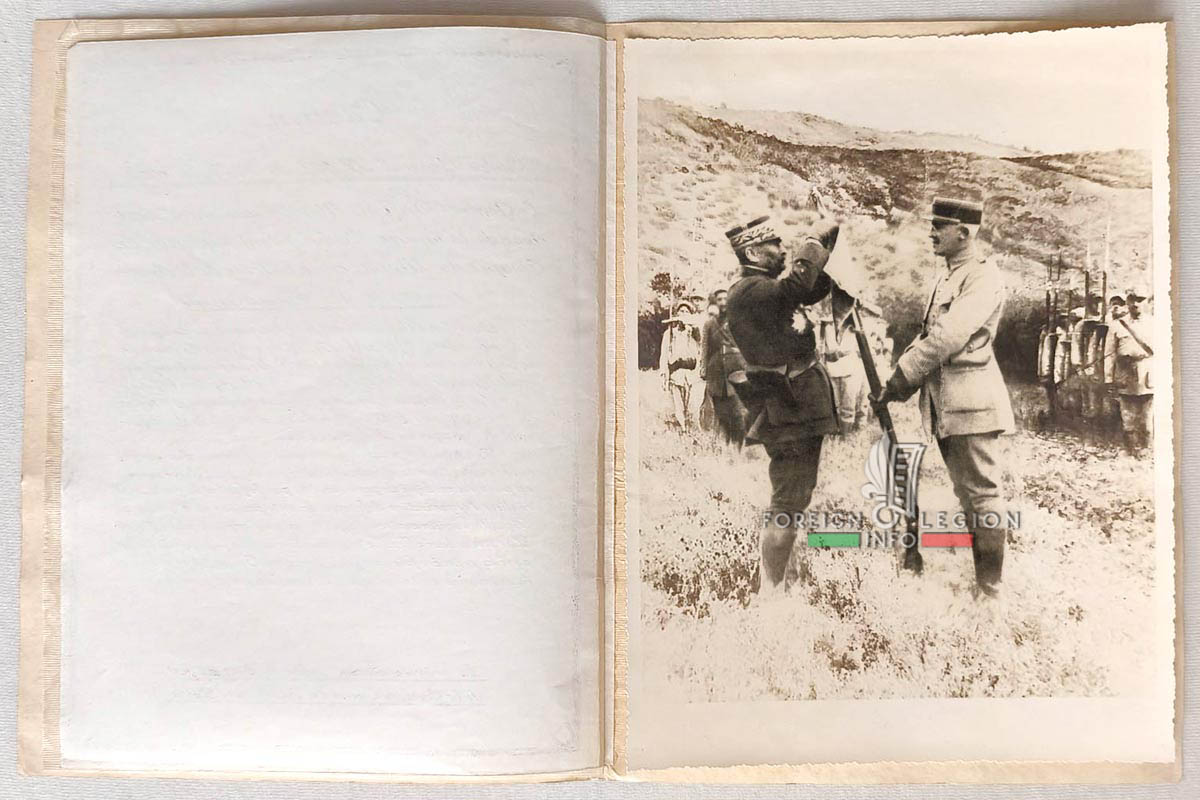
A little-known detail adds to the story. Although the citation is dated June 14, 1926, the battalion had already been cited under General Order No. 349 of May 25. This earlier order allowed General Boichut to decorate the battalion’s fanion on May 28, the day after Abd el-Krim’s surrender. It was subsequently annulled and replaced by General Order No. 362 of June 14, which contains the final version of the citation.
Unlike the ornate, roughly letter-sized certificates in which official citations usually survive, our piece takes the form of a specially produced presentation folder. This is what makes it unusual. The folder appears to have been a special commemorative item, most likely commissioned in a small series by the battalion commander as a keepsake for himself and its officers. Its stiff card covers bear the imprint of Studio Fernand Aimé, an established Moroccan photographic house founded by the French photographer Fernand Aimé (1891–1951). Active in Morocco from the early 1920s, the studio was based in Rabat and later maintained a presence in several major cities across the country, including Casablanca, Fez, and Meknès.
Take a closer look at the commemorative folder below. Click any image to view it in full detail.
—
Related posts:
DOCUMENTS: 1948 Cartoon Chronicle of Basic Training
DOCUMENTS: 1902-1913 1st Foreign Regiment certificates of Leg. Masquère
DOCUMENTS: 1959 1er REP Honorable discharge certificate of SCH Rutecki
PHOTOS: 1st Battalion 2e REI in Vietnam’s Faifo around 1950