
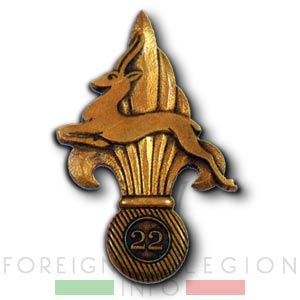
The 22nd Motorized Company (22e CP) of the 6th Battalion, 1st Foreign Infantry Regiment (1er REI), was formed on December 16, 1954, at the Nouvion camp (present-day El Ghomri), in the Mascara region of northwestern Algeria. One of the camps the Legion had at its disposal at the time, it had served as a training center for legionnaires bound for the Indochina War (1946–1954). A highly mobile infantry company whose men rode in vehicles, the 22e CP consisted of three motorized platoons under Captain Olivier Desjeux and was equipped with half-tracks and scout cars. Since the 6th Battalion did not yet exist, the company was designated a “fictitious” unit (unité fictive) and was administratively attached to the Foreign Legion Joint Depot (DCLE) in Sidi Bel Abbès, then the Legion’s headquarters.
In January 1955, the 22e CP left Nouvion for Laghouat, a town in the center of the country and the garrison of the 2nd Legion Saharan Motorized Company (2e CSPL). There, it joined its sister unit, the 21st Motorized Company, and for a time, all three Legion companies lived side by side. On January 25, 1955, the two motorized companies received their fanions (company pennants) from Lieutenant Colonel Arnault, commander of the DCLE and acting commanding officer of the 6th Battalion, which had not yet been formed.
In May, the scout cars were replaced by Dodge 6×6 trucks, which were better suited to missions in the desert regions south of Laghouat. Each motorized platoon was also equipped with three 81mm mortars.
On June 1, 1955, Captain Desjeux handed over command of the 22e CP to Captain François Lafontaine and left to join the 3e CSPL in Libya (in the Fezzan, where French troops remained until 1956).
That same day, the men of the company received the fourragère (a braided cord worn on the left shoulder as a collective unit decoration) in the colors of the ribbon of the Croix de Guerre des TOE (War Cross for Overseas Theaters of Operations). This decoration had been awarded to the former 6th Battalion 1er REI, for its actions in Morocco in 1925–1926, during the Rif War. The fourragère, however, would be worn for only a few weeks.


The 22e CPLE as an Independent Unit (1955–1956)
On July 1, 1955, the Legion’s headquarters was reorganized. The DCLE and the 1er REI were disbanded, and a new 1st Foreign Regiment (1er RE) was created in their place. The three motorized companies of the 6th Battalion, which had never really been re-formed, became independent. The 22e CP was accordingly renamed the 22nd Foreign Legion Motorized Company (22e Compagnie portée de Légion étrangère, 22e CPLE).
Still based in Laghouat, in the Ghardaïa region, the company spent the summer there, with one platoon detached to Djelfa (northeast of Laghouat) and another to El Houaita, to the southwest. The men were kept busy maintaining order, training, firing practice, and woodcutting around El Houaita, an important task, since wood was a scarce fuel in this desert region. At the same time, the legionnaires, true to their nickname of “soldiers and builders,” built a swimming pool in Djelfa.
In September, the company left Laghouat and moved to Djelfa, where it received five M8 armored cars to form an armored car platoon. Then, on September 13, the 22e CPLE moved to Zeribet El Oued, in the Biskra region of eastern Algeria, to replace the 1re CSPL. There, it took up quarters in Bordj Jumenterie (a fort).
In late September, the men of the company took part in Operation Timgad, a large combined-arms operation on the Tunisian border, not far from Djebel El Djorf (djebel means mountain), in the Tébessa region. They fought alongside their comrades from the 21e CPLE and 23e CPLE, the 1re CSPL and 2e CSPL, the 1st Foreign Parachute Regiment (1er REP), and the 2nd Foreign Infantry Regiment (2e REI). A major gathering of rebel leaders from the Aurès and Nementcha mountains was wiped out. For this operation, the CPLEs and CSPLs were brought together in a “Foreign Legion Motorized Company Group” under Lieutenant Colonel Brisbarre, an officer of the Colonial Troops.
In late October came another operation. Legionnaire Olszewski was killed, and a lieutenant and two legionnaires were wounded.
The 22e CPLE’s new military missions and the construction of a more comfortable post alternated with population checks, convoy escorts, and patrols across the pre-Saharan plains. One of the company’s platoons was stationed at Ouled Djellal, some 75 miles (120 km) west of Zeribet El Oued. Isolated from the rest of the company, it operated entirely on its own.
The 22nd Motorized Company of the GPLEA (1956)
In January 1956, the company undertook a long-distance expedition into the Sahara, covering about 375 miles (600 km). With its two large GMC trucks loaded with gasoline and its 8-ton armored cars, however, progress through the sand dunes was at times barely 100 yards (100 m) an hour.
In February 1956, the Foreign Legion Algerian Motorized Group (GPLEA) was created. The new group was to bring together the three motorized companies of the former 1er REI, scattered across eastern Algeria, which would thereby lose their administrative autonomy. The 22e CPLE was thus to become the 22nd Motorized Company of the GPLEA. In practice, however, the integration did not take place until June.
In the second half of 1956, the men of the company wore the Saharan uniform at ceremonies, with its characteristic seroual (wide, baggy trousers) decorated on the side with the Agadez cross, a symbol of the Tuareg of the Sahara.
In late October 1956, the GPLEA, a little-known and short-lived unit, was disbanded, and its elements were absorbed into the 2e REI. The 22nd Company of the GPLEA, still stationed at Zeribet El Oued, thus became the 5th Motorized Company, 2e REI (5e CP/2).
A few days later, on November 5, 1956, Adjoul-Adjoul, one of the rebel leaders of the Aurès region, surrendered to the company’s legionnaires at the Zeribet El Oued post.
In March 1957, the 5e CP/2 (the former 22e CPLE) joined the 2e REI at its headquarters in Aïn Sefra, in western Algeria.


———
L'article en français : 22eme CPLE : 22e Compagnie Portée de Légion Etrangère
———

———
Main information sources:
Képi blanc magazine
Foreign Legion annual bulletins (1950s)
J. Brunon, G.-R. Manue, P. Carles: Le Livre d’Or de la Légion (Charles-Lavauzelle, 1976)
Tibor Szecsko: Le grand livre des insignes de la Légion étrangère (S.I.H.L.E., 1991)
———
More from the Foreign Legion’s history:
23rd Foreign Legion Motorized Company
Mounted and Motorized Company Group, 3e REI
PHOTOS: 2nd Motorized Company GPLEM in Taroudant, Morocco, in 1954
4th Legion Saharan Motorized Company
———
The page was updated on: October 15, 2026