
The Franco-Prussian War (1870–1871) brought the Foreign Legion to French soil for the first time in its history. The legionnaires fought in a harsh winter campaign against a superior enemy, from Orléans to the Swiss border, in a war that was already lost.
—
L'article en français : Guerre franco-prussienne de 1870
—

Historical Background
After the Austrian defeat in the 1866 Austro-Prussian War, the North German Confederation was formed under Prussian hegemony, with Otto von Bismarck as the federal chancellor. With a modern army and efficient administration, Prussia became a formidable European power.
On the other hand, the Second French Empire of Emperor Napoleon III found itself isolated in Europe and weakened internally. The French army was diminished after the failed Mexican campaign (1862–1867), and the emperor’s health was rapidly deteriorating.
In July 1870, a diplomatic quarrel – the “Ems Dispatch,” concerning the Spanish throne – provoked the French government to issue a hasty declaration of war on Prussia on July 19. France thus initiated the hostilities, facing an enemy that enjoyed a marked superiority in mobilization and organization. Prussia would soon deploy forces far outnumbering those immediately available to the French.
The war went badly from the start. The French were severely defeated in the first battles in Alsace in early August. After these defeats, Napoleon III entrusted Marshal Bazaine with command of the Army of the Rhine, which was soon besieged in Metz. A second army under Marshal MacMahon was formed, but the decisive blow came on September 2 at Sedan, where MacMahon’s forces capitulated and Napoleon III was taken prisoner.
Following this catastrophe, the fall of the Empire and the establishment of a new republic were proclaimed in Paris on September 4. The new republican Government of National Defense declared its intention to continue the struggle. Its Minister of the Interior, Léon Gambetta, left Paris by balloon and set up headquarters in Tours, from where he directed the creation and reorganization of new provincial armies, including the Army of the Loire, the Army of the North, and the Army of the East.
It was in this critical situation that the Foreign Legion entered the war.


Foreign Legion in the Franco-Prussian War
At the time of the declaration of war on Prussia, the Foreign Legion was serving in Algeria, North Africa, under the title of Foreign Regiment (the former 2nd Foreign Regiment, 2e RE). Like other French units, the regiment was reduced following the Mexican campaign, during which the legionnaires distinguished themselves at the 1863 Battle of Camerone. In mid-July 1870, the whole Legion comprised only 117 officers and 2,457 men. Divided into four battalions, they maintained order in western Algeria, with the HQ in Mascara.
Meanwhile, men were urgently needed for the coming conflict. On July 17, a French imperial law authorized voluntary wartime service enlistment (EVDG). However, contrary to what other historical works have suggested, this law was not aimed primarily at foreign volunteers, as would later be the case in 1914 and 1939. For example, in August 1870, more than 25,000 wartime volunteers were recruited into the French infantry – but among them, only 557 foreigners (2%).
5th Battalion of the Foreign Regiment
An imperial decree dated August 22 authorized the creation of the 5th Battalion of the Foreign Regiment in France, to integrate the foreign volunteers who wanted to serve under the French flag. This was an exceptional wartime measure. In fact, under the law of March 9, 1831, the legionnaires were only permitted to serve outside metropolitan France. That is the reason why the Foreign Legion was stationed in Algeria. However, during the war of 1870–1871, this ban was temporarily suspended.
The 5th Battalion was organized in Tours, which had already been designated in July as the future depot for deserters from foreign armies. A circular sent out by the new republican government on September 5 instructed that all Prussians and citizens of German states should be refused enlistment; those already enlisted were to be transferred to Algeria.
Commanded by Major Victor Arago, the new battalion consisted of some 1,250 men divided into eight companies – mostly Austrians, Belgians, Swiss, Poles, Italians, and Spaniards. Among the officers was Second Lieutenant Kara George, also known as Prince Karageorgevitch, the future King Peter I of Serbia. Half of the battalion’s men were armed with the Chassepot, the first breech-loading rifle, while the remainder were equipped with percussion muskets.
The 5th Battalion was assigned to the 15th Army Corps, part of the Army of the Loire. On September 30, it left Tours for Orléans, about 75 miles (120 km) south of Paris, and arrived there on October 10.
Almost immediately, the battalion was drawn into the defense of the city against Prussians and Bavarians under General von der Tann. Street fighting broke out around two o’clock in the morning on October 11 and continued throughout the day. Defending the Faubourg Bannier, a suburb of Orléans, the legionnaires fought from house to house, from garden to garden. A sergeant distinguished himself as an excellent marksman and, positioned behind a skylight, killed some 80 enemy soldiers.
At five o’clock in the afternoon, Major Arago was killed, and the order to retreat was sounded almost at once. Now under Captain Morancy, the legionnaires responded with the cry ‘Forward!’ and held their position on the square. They obeyed only the third call and then withdrew.
The 5th Battalion lost two-thirds of its strength: 600 dead or wounded, 200 to 300 taken prisoner. Of 25 officers, six were killed, seven wounded, six imprisoned. The courage of the men was admired even by the enemy.
5th Battalion’s officers killed on October 11, 1870:
- Major ARAGO Victor – battalion commander
- Captain CHARNAUX François
- Second Lieutenant KACZKOWSKI Stanislas
- Second Lieutenant FAY H.-J.
- Second Lieutenant YUNG DE CRISTOFEU
- Second Lieutenant KURNEWITCH
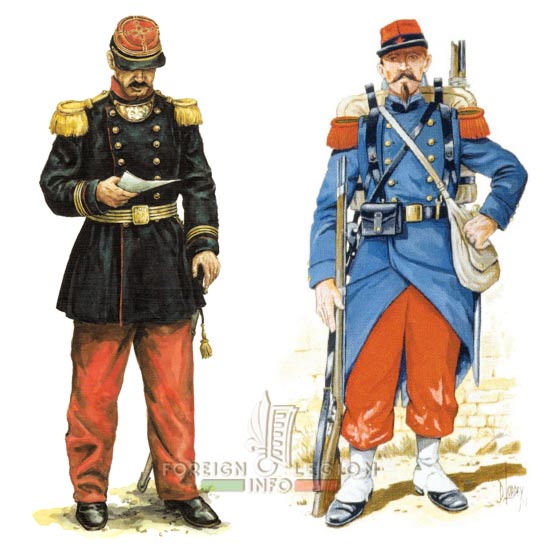


Foreign Marching Regiment
The Foreign Marching Regiment was an improvised field formation created for service in France from battalions of the Foreign Regiment in Algeria and the remnants of the 5th Battalion already fighting on French soil.
On September 22, 1870, Colonel Deplanque – then the head of the Foreign Regiment based in Algeria – received an order to send to France two volunteer battalions, from which German legionnaires of all ranks would be removed and left in Africa. The 1st and 2nd Battalions were chosen. Raised to eight companies each, they landed in France on October 11. Their total strength was 60 officers and 1,457 men, commanded by their colonel. On October 19, in the Orléans region, the two battalions were joined by the considerably reduced 5th Battalion, under its new commander, Major Béchet. The whole group formed the Foreign Marching Regiment (Régiment Etranger de marche), a provisional field formation created for service in France.
The regiment consisted of no more than 2,000 men and remained within the 15th Army Corps. This corps was composed of troops recalled from Algeria, soldiers from depots, and reservists. Its mission was to oppose the German advance in the Loire region and, if possible, to contribute to operations intended to relieve besieged Paris.
Meanwhile, events elsewhere on the front were about to make the situation considerably worse. On October 27, the former Army of the Rhine led by Marshal Bazaine (150,000 men), which had been under siege in Metz since the end of August, surrendered. This was a serious blow to France, but the republican armies newly raised in the provinces continued the struggle.
On November 9, the Foreign Marching Regiment took part in the Battle of Coulmiers to the west of Orléans, driving back the Bavarians. The legionnaires then recaptured Orléans, which they had lost in October. This battle was the most significant victory won by the French army during the 1870-1871 war. But snow and rain were already falling heavily, and movement became extremely difficult.
A few days later, Colonel Deplanque was promoted to general. Colonel de Curten, newly arrived from Algeria, replaced him as head of the regiment, but was himself promoted to general two weeks later. Stable command was finally assumed by the newly promoted Lieutenant Colonel Canat, who led the regiment until the end of the campaign.
On December 3, the legionnaires distinguished themselves at the Croix-Briquet, north of Orléans, with their determined resistance against the Bavarians of General von der Tann. The next day, a battle between Cercottes and Chevilly occurred. With bayonets fixed, the legionnaires charged and forced the enemy to withdraw. However, the Germans regained the initiative owing to the number of troops at their disposal. The 15th Army Corps was ordered to retreat. Eventually, on December 4, the forces of Prince Friedrich Karl of Prussia recaptured Orléans.
The retreat continued under heavy snow toward Bourges, the depot of both the 5th Battalion and the Foreign Marching Regiment. The men were exhausted from cold, hunger, and constant marching. Morale fell rapidly. Severely depleted by the fighting, the regiment was consolidated into a single battalion of only about 900 men.
In Bourges, however, the unit was reorganized and reinforced as part of an emergency effort to rebuild the shattered army. It was also joined by Irish Company, the only unit to emerge from the planned 2nd Foreign Regiment (“Irish”), which never fully materialized. Between December 18 and 23, some 2,000 young recruits reinforced the regiment, increasing its strength to about 3,000 men. These recruits came from the depots of eight line regiments (the 7th, 12th, 21st, 48th, 68th, 69th, 70th, and 71st). Mostly Bretons, they had received little or no basic training. The regiment now had three eight-company battalions and a reconnaissance company.
On January 7, 1871, the Foreign Marching Regiment left Bourges and was transferred to General Bourbaki’s Army of the East, as the French command redirected its remaining forces toward a new theater of operations near the Swiss border. The cold was so intense that many men suffered frostbite during the march. Upon their arrival in Montbéliard on January 15, the legionnaires set up camp west of the town, which was located near the Swiss border. On January 20, after a few skirmishes with the Prussians of General von Werder, the regiment withdrew westward toward Besançon. On January 25 and 26, its battalions were heavily engaged.
On January 28, 1871, the Franco-German armistice was signed. The Army of the East, however, was excluded from its terms. After General Bourbaki handed over command to his deputy, General Clinchant, the latter negotiated the army’s internment in Switzerland to avoid capitulation and captivity. On February 1, nearly 90,000 men began to cross the border.
The Foreign Marching Regiment, on the other hand, remained near Besançon, still facing the Prussians. Finally, on February 15, the general armistice took effect and allowed the men to rest. The war was finally over.
But the end of hostilities with Germany did not bring peace to France. The country remained in deep political and social turmoil, and during the turbulent weeks that followed the French began to fight among themselves. By order of the new government, the three battalions of the Foreign Marching Regiment would actively participate in the suppression of the uprising in the capital later known as the Paris Commune. In an irony of history, this took place during the Legion’s very first deployment on French soil.
On June 15, 1871, the three battalions finally left France for Algeria. A week later, the legionnaires joined the headquarters of the Foreign Regiment in Mascara.


Legion’s Forgotten Units in the Franco-Prussian War
The account above follows the well-known narrative of the Legion’s role in the conflict. Official works published by the Foreign Legion, as well as most historical studies concerned with the Legion’s activities in France during the Franco-Prussian War, deal only with the battalions mentioned above. Archival research, however, suggests a more complex picture, revealing other units formed – or at least projected – between 1870 and 1871 that have since been virtually forgotten.
Foreign Legion Company of the Brittany Division
This company remains one of the least documented formations in Legion history. Only a few scattered details about it survive, and they may be summarized as follows.
In late September 1870, a company of the Foreign Regiment’s 5th Battalion left Tours for Brittany, the homeland of the Celtic Bretons in western France. Composed of two officers and approximately 190 insufficiently trained men, the unit moved to Brest, the second largest military port in France since 1865. The company stayed there from October 1 to November 6, when it left for the Conlie camp, not far from Le Mans. The camp served as a gathering and training point for thousands of Breton volunteers during the war and became notorious for its poor conditions.
There, its cadre was completed. The company was then assigned to the Brittany Division (officially the 4th Division of the 21st Corps), a single active part of a new reserve army, the Army of Brittany under General de Kératry. In December, the Brittany Division would reinforce the Second Army of the Loire, the latter formed by splitting the original Army.
In the orders of battle, the company is mentioned as the “Foreign Legion Company” (Compagnie de la Légion étrangère).
The unit, whose men’s nationality is not indicated in any known source, was detached to irregular military formations (francs-tireurs) to conduct what was often guerrilla warfare.
In January 1871, the Foreign Legion Company took part in the bayonet charge during the Battle of Le Mans against the troops of Prince Friedrich Karl of Prussia, and protected the division’s artillery and convoys during the subsequent retreat. During these battles, the company suffered considerable losses. It was then sent, along with the entire division, to defend Brittany. There, in Rennes, this poorly documented unit was disbanded.
Unfortunately, this unit’s precise role remains unclear, as do the reasons why it was detached from the 5th Battalion and sent to Brittany. As a result, one can only speculate whether it was intended, for example, as a disciplinary formation, and who the men serving in it actually were.
6th Battalion of the Foreign Regiment
In the final weeks of the war, as the Brittany Division company fought at Le Mans, the government decided to raise yet another unit comprising foreign volunteers. This one would be organized in the north – this time not as a detachment, but as a newly raised battalion. It remains as obscure as its smaller counterpart in Brittany. This battalion is not mentioned in any official Foreign Legion source, nor in most historical works. The following offers, for the first time, a closer look at this largely overlooked unit.
At the end of December 1870, the Government of National Defense decided to raise a new unit within the Foreign Regiment, this time in northern France. Thus, a decree was signed on January 12, 1871. It ordered the creation of the 6th Battalion, which was to have six companies and be administered separately from the rest of the regiment. Its depot had been set up a few days prior in Saint-Omer, a small town between Lille and Calais. Also, as early as January 4, Major Charles Gache from the 49th Line Regiment was appointed commander. Called the “6th Foreign Battalion” or “Foreign Battalion of Saint-Omer,” this unit would be assigned to General Faidherbe’s recently formed Army of the North.
The majority were French and Belgian recruits, although there were some Dutchmen and men of other nationalities. Among the first seven officers of the battalion were two Belgian second lieutenants, Bayet and Herber, and Second Lieutenant Turno-Przybylski, of Polish origin. It is interesting that all three officers came from ordinary French units rather than from the Foreign Regiment. This suggests that a number of foreigners served in French metropolitan units during the 1870 war without being transferred to the Foreign Legion.
Despite the freezing weather and desperate course of the war on the French side, recruitment increased quite rapidly. In early February 1871, the total strength of the battalion was 12 officers and 215 men. Four weeks later, it already comprised 16 officers and 324 men, divided into an HQ, an HQ platoon, four active companies and a depot company (the 6th, under Captain Fouchet). However, the armistice marked the end of the war in France and made it impossible for this unit to join the fight. In April, it left Saint-Omer for North Africa, through the port of Dunkirk.
The 6th Battalion disappears from the official documentation after its departure from Saint-Omer. Its later history can nevertheless be partly reconstructed from Major Gache’s 1880 correspondence and from operational records showing a detachment of the Foreign Regiment under his command in western Algeria.
In his correspondence from 1880, Major Gache points out that “… when the armistice came, my Battalion had just been incorporated into the Foreign Regiment. I led it urgently to Algeria, where the great insurrection of 1871 had just broken out. My Battalion operated in the Sahel, the country situated between Miliana and Cherchell, and finally in December, in the south of the Oran province.”
And the operational records confirm this. They show that from late May 1871 onward, “… a detachment of the Foreign Regiment, composed of 12 officers and 585 men under Major Gache” formed part of the columns of Colonels Désandré (May-June), Goursaud (June-July), and Nicot (July-September) in the region between Miliana and Cherchell, located about 60 miles (100 km) southwest of Algiers, the capital. In other words, a little-known battalion from northern France spent three months in fierce fighting against Berber rebels.
In December 1871, by order of the Minister of War, the French and wartime volunteers of the 5th and 6th Battalions were discharged; the Foreign Regiment thus lost around 1,200 men. As for the foreigners serving in these units, they were transferred to the remaining battalions.


Conclusion
The Franco-Prussian War was a tragic conflict. It deeply shook French society and the self-esteem of the French, unleashing divisions that would culminate in the Paris Commune and its violent suppression just months later. In addition to its defeat, France lost most of Alsace and part of Lorraine, annexed in 1871 by the newly proclaimed German Empire.
For the Foreign Legion, the war marked a significant moment: for the first time, legionnaires fought on French soil. This deployment was made possible only by the desperate circumstances following the fall of the Empire. The men of these Foreign Legion units showed considerable endurance despite harsh conditions, bitter cold, and a war that was already lost.
Notably, the Legion was not the only option for foreigners willing to fight for France. During the war, a number of military units composed of foreign volunteers were formed outside the administration of the Legion – most notably Giuseppe Garibaldi’s Army of the Vosges, as well as several smaller irregular corps francs in Paris and elsewhere. British and American volunteers also provided medical assistance to wounded French soldiers. These units are the subject of a separate article: Other Foreign Volunteer Corps in the 1870–1871 Franco-Prussian War.
As for the war itself, this would be the first time that “wartime service enlisted volunteers” (EVDG) appeared. However, those men were mainly French, not foreigners – unlike the waves of foreign EVDG volunteers that would characterize both world wars. Another interesting fact is that many foreign volunteers on the French side enlisted in military units that had no connection to the Foreign Legion.
Finally, the Franco-Prussian War led to lasting restrictions on German candidates for the Legion, with certain exceptions – notably for men originating from the Alsace-Lorraine region who, following the annexation, held German nationality. This decision considerably affected both the Legion’s national composition and its overall character until 1914.
———
Main information sources:
Képi blanc magazines (1959, 1961)
Gen Grisot, Ltn Coulombon: Légion étrangère 1831 à 1887 (Berger-Levrault, 1888)
Various Authors: La Guerre de 1870-71 – La Défense Nationale En Province (R. Chapelot et Cie, 1911)
Various Authors: La Guerre de 1870-71 – Campagne de l’Armee du Nord – IV – Saint-Quentin (R. Chapelot et Cie, 1904)
Aristide Martinien: La Guerre de 1870-1871 – La Mobilistation de l’Armee – Mouvements des dépots (L. Fournier, 1912)
Ferdinand Lecomte: Guerre franco-allemande en 1870-1871 – Tome III (Genève et Bale, 1872)
Alexandre Dupont: Les volontaires espagnols dans la guerre franco-allemande de 1870-1871 (Mélanges de la Casa de Velázquez Nº 45, 2015)
Amédée Le Faure: Histoire de la guerre franco-allemande 1870-71 – Tome I (Garnier frères, 1875)
Gustave Schelle: Œuvres de Turgot – Tome III (Librairie Félix Alcan, 1919)
La Liberté daily (Septembre 1870)
La Petite Presse daily (Novembre 1870)
Le Rappel daily (Novembre 1870)
L’armée de la Loire 1870-1871 (Fr)
Google.com
Wikipedia.org
———

———
Discover the Foreign Legion’s history:
Second Franco-Dahomean War 1892-1894
Foreign Legion in the Balkans: 1915-1919
French Foreign Legion in World War II
Foreign Legion in Madagascar 1947-1951
———
The page was updated on: March 13, 2026