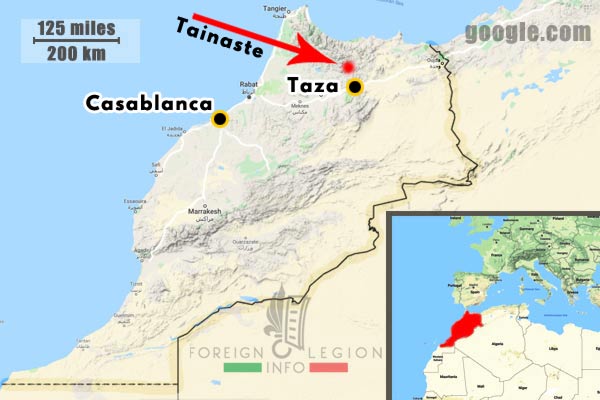
In the mid-1950s, violence against French military, administrative, and civilian targets spread across French North Africa, which included Tunisia, Algeria, and Morocco. At the beginning of 1956, several Foreign Legion units were stationed in Morocco. One of those units was the 2nd Foreign Infantry Regiment (2e REI), commanded by Lieutenant Colonel Jacquot. The regiment was based in northern Morocco, in the Taza region. The area was already well known to the Legion.
In late January 1956, however, the 2e REI suffered heavy losses there. Major Escaron’s 3rd Battalion was attacked by local rebels near Tainaste, about 25 miles (40 km) north of Taza. It was the Legion’s largest combat loss in Morocco since the end of the country’s pacification in 1934. It also ranked among the Foreign Legion’s three heaviest single-battle losses during the wider conflict now commonly known as the Algerian War (1954–1962).
What happened?
On the morning of January 28, 1956, the 11th Company of the 3rd Battalion set out on a routine patrol. It advanced north, following the ridgelines along the Tahar–Souk road. The battalion’s Support Company (CA), under Captain Fraisse, conducted reconnaissance in the steep gorges. At the same time, the 10th Company advanced on the road. The three companies headed for the Aknoul crossroads, where they met at 11:00 a.m.
After a brief halt, the units began to move out in different directions. Soon afterward, the rear of the 10th Company was attacked; two legionnaires fell. Hearing the firing, Captain Ungerman’s 11th Company moved back to the crossroads to support the 10th, only to come under heavy fire. Meanwhile, a large rebel group moved toward Tainaste to cut off the withdrawal route.
Once the initial surprise passed, Lieutenant Schmidt’s platoon, part of the 11th Company, attacked a slope held by a particularly well-equipped, well-trained enemy commando unit that was pouring intense fire into the Legion’s position. The platoon pushed uphill and closed until it was nearly face-to-face with the enemy. Lieutenant Schmidt, a former legionnaire who had risen through the ranks, was killed along with half of his men.
Later, the bodies of 21 Riffians (rebel tribesmen from northern Morocco), including their leader, were recovered there, along with a dozen weapons.
Elsewhere, Captain Ungerman, with the rest of the 11th Company, held off dozens of rebels who had closed to within 50 yards. The 10th Company was pinned down while trying to outflank the enemy. Alerted by radio, the Support Company sent forward two platoons under 2nd Lieutenant Verwaerde and Lieutenant Monin. They pressed the counterattack. Captain Fraisse also advanced tenaciously with his remaining platoon, pushing back the delaying elements ahead of him. In doing so, he threatened the adversary with encirclement.
Around 6:00 p.m., the last element of the 3rd Battalion – the 9th Company – finally reached the battlefield. It had maintained radio contact with its comrades from the start of the engagement.
The 11th Company was out of ammunition but held its position. The 10th Company and the Support Company did the same.
With nightfall, the fighting subsided, but the situation remained tense. The legionnaires decided to stay on the spot even though the rebels held the ridges less than 1,500 yards away. All night, under the protection of armored cars, the 2e REI men transported the dead and wounded, while bringing in food and ammunition. However, the fighting did not resume. The enemy quietly disappeared, and the battalion therefore returned to Taza.
The intensity of the attack, carried out by about 300 rebels, had surprised everyone. On the Legion side, roughly 180 legionnaires were engaged: 18 were killed, including Lieutenant Schmidt and Staff Sergeant Schuster, and eight were wounded. Rebel losses totaled 55 dead.
On January 31, a funeral for the fallen legionnaires took place in Taza. Four weeks later, Morocco gained its independence from France. The 2e REI that had been present at France’s first actions in Morocco a half-century earlier now left the country entirely and moved to Algeria.