
In northern Vietnam in the autumn of 1945, a new unit was established, bringing together the surviving members of the 5th Foreign Infantry Regiment (5e REI) who remained in the area at the time of Japan’s surrender. Though virtually unknown today (unlike the 5e REI’s much better-documented marching battalion – BM 5 – formed in China), it was the first Foreign Legion formation to reappear within the borders of French Indochina after World War II, reaffirming the Legion’s enduring presence in this territory.
—
L'article en français : Bataillon formant corps du 5e REI
—
Introduction
Created in 1930, the 5e REI served in Indochina, primarily in Tonkin (Northern Vietnam under French colonial rule). As an overseas regiment, his men operated on the basis of two- to three-year tours of duty. In 1941, it received its last reinforcements, as the colony had been cut off by the British naval blockade, a direct result of the Vichy government’s collaboration with Nazi Germany.
Most of the officers and legionnaires had arrived in 1938 or 1939, some even earlier, and thus saw their stay forcibly extended until the end of the war. The regiment first faced Japanese troops, Germany’s allies, who partially occupied Indochina in 1940 while allowing the French colonial administration to remain in place under Vichy authority. Then, in January 1941, the regiment took part in combat operations in Cambodia against the Siamese (Thai) invasion. The following years passed in relative calm, though marked by the total isolation of French forces in Indochina.
On March 9, 1945, a Japanese coup d’état abruptly ended that period. Fearing that the French garrison might rally to the Allies, Japanese forces attacked French positions and massacred a large portion of the troops, including several detachments of the 5e REI. The regimental commander was captured, and his chief of staff was killed.
Nevertheless, three battalions managed to join the column led by General Alessandri – a former commanding officer of the regiment – and fought their way into China, where the survivors formed the Marching Battalion of the 5e REI (bataillon de marche, BM 5), an ad hoc combat unit composed of remaining 5e REI elements.
Formation of the BFC 5
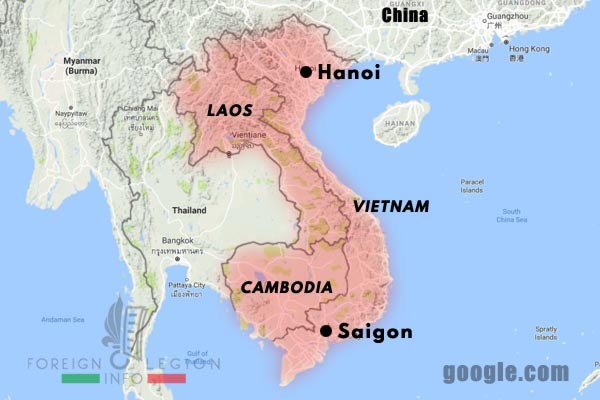
After Japan’s capitulation in early September 1945, the situation in Indochina remained chaotic. The territory was divided into occupation zones: the north was held by Chinese troops, and the south by the British. On September 2, 1945, the city of Hanoi in Tonkin became the capital of the Democratic Republic of Vietnam proclaimed by Ho Chi Minh, a communist leader and head of the Viet Minh movement, while France sought to re-establish its colonial authority.
On October 13, 1945, in Hanoi, the Autonomous Battalion of the 5th Foreign Infantry Regiment (Bataillon formant corps du 5e REI, BFC 5) – a battalion administratively independent and acting as a regiment’s nucleus – was formed on the orders of General Raoul Salan, commander of French forces in China and northern Indochina, with the support of Jean Sainteny, the French commissioner for Tonkin and northern Annam (central Vietnam). Faced with the Chinese authorities’ refusal to allow French troops from the south to move northward – or to permit the return of French units that had taken refuge in China, including the BM 5 – Salan decided to re-establish a French presence locally with whatever means were available.
Around two to three hundred veterans of the 5e REI still remaining in Tonkin – survivors of the March 1945 fighting, men cut off from General Alessandri’s column, or soldiers who had been hospitalized during the Japanese coup – came together to form this new Foreign Legion unit. They had survived the brutal conditions of Japanese captivity, during which they endured great suffering and witnessed many of their comrades die of exhaustion and disease. These men, whose average age was forty-two and who had an average of twenty-one years of service, included a remarkable number of decorated soldiers: nearly 60 percent had been cited for valor at Lang Son and Cai Kinh in 1940, or in Cambodia in 1941, and more than 30 percent either wore or were due to receive the Médaille militaire, one of France’s highest decorations for non-commissioned officers and enlisted personnel. One warrant officer, Adjudant Roman of the 5e REI’s Motorized Detachment (DML), was even awarded the Légion d’honneur – France’s highest order of merit – for his courage during the defense of the Hanoi Citadel in March 1945, where he was wounded four times, the last very seriously.
Major Joseph Dumaine, an officer of the 1st Tonkinese Rifle Regiment (1er RTT), was appointed to command the battalion, as no Foreign Legion officer of equivalent rank was still present in Tonkin. In March 1945, Dumaine and his men – the last defenders of the Hanoi Citadel – held out against the repeated Japanese attacks until the very end. The major then distinguished himself by saving the regimental flag of the 1er RTT, France’s second oldest regiment created in Indochina, which he wrapped around his body to prevent its capture.
His deputy was Captain Besset, an officer with an exceptional career. He had first enlisted in the Foreign Legion under a false identity in the early 1920s, serving for five years as a simple legionnaire and then as a non-commissioned officer. Rejoining the Legion in 1934, this time as an officer, he arrived in Indochina four years later. In March 1945, he took part in the long and exhausting retreat to China with the 2nd Battalion of the 5e REI, which he temporarily commanded after his superior was seriously wounded in combat against the Japanese. At forty-seven years old, he represented the archetype of a seasoned, battle-hardened Legion veteran. The circumstances of his presence in Hanoi in October 1945, at the time of the BFC 5’s creation, remain unclear, however.

Activity and Dissolution
Between October 1945 and early 1946, the BFC 5 underwent intensive training. By the end of March, the first French troops arriving from the south – under the command of General Leclerc, hero of World War II – reached Hanoi to relieve the Chinese forces that were in the process of withdrawing. On March 19, 1946, Leclerc visited the Hanoi Citadel and reviewed the French troops stationed there, among them the BFC 5. On that occasion, he congratulated Major Dumaine on saving the 1er RTT’s regimental flag a year earlier.
Soon afterward, in April, at Leclerc’s request, the BFC 5 was sent south to reinforce French forces stationed in Cochinchina (southern Vietnam). At the same time, the BM 5 – which had come from China – was deployed in Laos, where it continued its operations until September.
The Autonomous Battalion in Cochinchina took part in operations to restore order in the Saigon–Cholon urban area. It was also engaged in counter-insurgency actions in the Plaine des Joncs region – a vast wetland southwest of Saigon – against Viet Minh elements and local militias. It fought alongside young legionnaires of the 13th Foreign Legion Half-Brigade (13e DBLE), which had only recently arrived in Indochina.
On April 30, 1946, a major military parade was held on Boulevard Norodom in Saigon, in the presence of General Juin, Chief of the French General Staff, and General Leclerc, Commander-in-Chief of the French Far East Expeditionary Corps (CEFEO). During this parade, the 1st Company BFC 5 led a combined detachment of the “Veterans of Indochina”, commanded by Major Dumaine. These veterans marched behind the 3rd Foreign Infantry Regiment (3e REI), another newly arrived unit whose men were on average twenty-one years old and had barely one year of service. The parade thus marked a symbolic passing of the torch between the two generations of legionnaires and reaffirmed the continuity of the Legion in the Far East.
Later, some of the BFC 5 veterans were promoted and, upon request, joined newly arrived Legion units – the 2e REI, 3e REI, 13e DBLE, and smaller engineering units. These veterans helped transmit the Legion’s traditions and strengthen the esprit de corps within formations composed mainly of new recruits.
On October 31, 1946, both the BFC 5 and the BM 5 were officially disbanded. Nevertheless, their men still took part in the Armistice Day parade held in Saigon on November 11, distinguished by their “faded” uniforms. A month later, on December 12, they boarded the ship Sontay bound for Algeria. The surviving members of the 5e REI – representing the last remnants of the old, pre-war Foreign Legion – disembarked in Algiers on January 16, 1947. There, they were formally welcomed by the regional commanding general before returning to Sidi Bel Abbès, the historic headquarters of the Foreign Legion. Some later rejoined Legion regiments deployed in Indochina after a period of rest in Algeria or in metropolitan France.
Captain Besset, however, chose to retire after thirty uninterrupted years of service in the military, including eighteen in the Legion. Ten years later, in 1957, he became director of the Maison du Légionnaire (the Legionnaires’ retirement home) in Auriol, southern France. Incidentally, an important part of the information about the 5e REI’s odyssey during 1945 is based on articles and firsthand accounts published by Besset himself.
March of the BFC 5
To strengthen the battalion’s cohesion and revive its esprit de corps, Major Dumaine decided, at the end of 1945, to give the BFC 5 its own march: Marche du BFC du 5e REI. He wrote the lyrics himself, while the music was composed by Assistant Bandmaster Calippe – the deputy conductor of the BFC 5 battalion’s band.
In June 1967, by then a colonel and an active member of the Legion veterans’ association in Tarbes (southern France), Dumaine arranged for the Foreign Legion Band to perform the march during its visit to the city. He had it played in tribute to his former deputy in the BFC 5, Colonel Besset, who had served for the past ten years as director of the Maison du Légionnaire, and who had passed away only a few weeks earlier.
This gesture symbolically closed the story of the BFC 5 – the first unit of the Foreign Legion to reappear in French Indochina after the Second World War.


———
Main information sources:
Képi blanc magazines
Vert et Rouge magazines
Caravelle magazines
———
More from the history of the Foreign Legion:
French Foreign Legion in World War II
11th Foreign Infantry Regiment
97th Division Reconnaissance Group
History of the 13th Foreign Legion Demi-Brigade
Legionnaires paratroopers in WWII
Foreign Legion Artillery Batteries
———
This article was updated on: October 17, 2025